
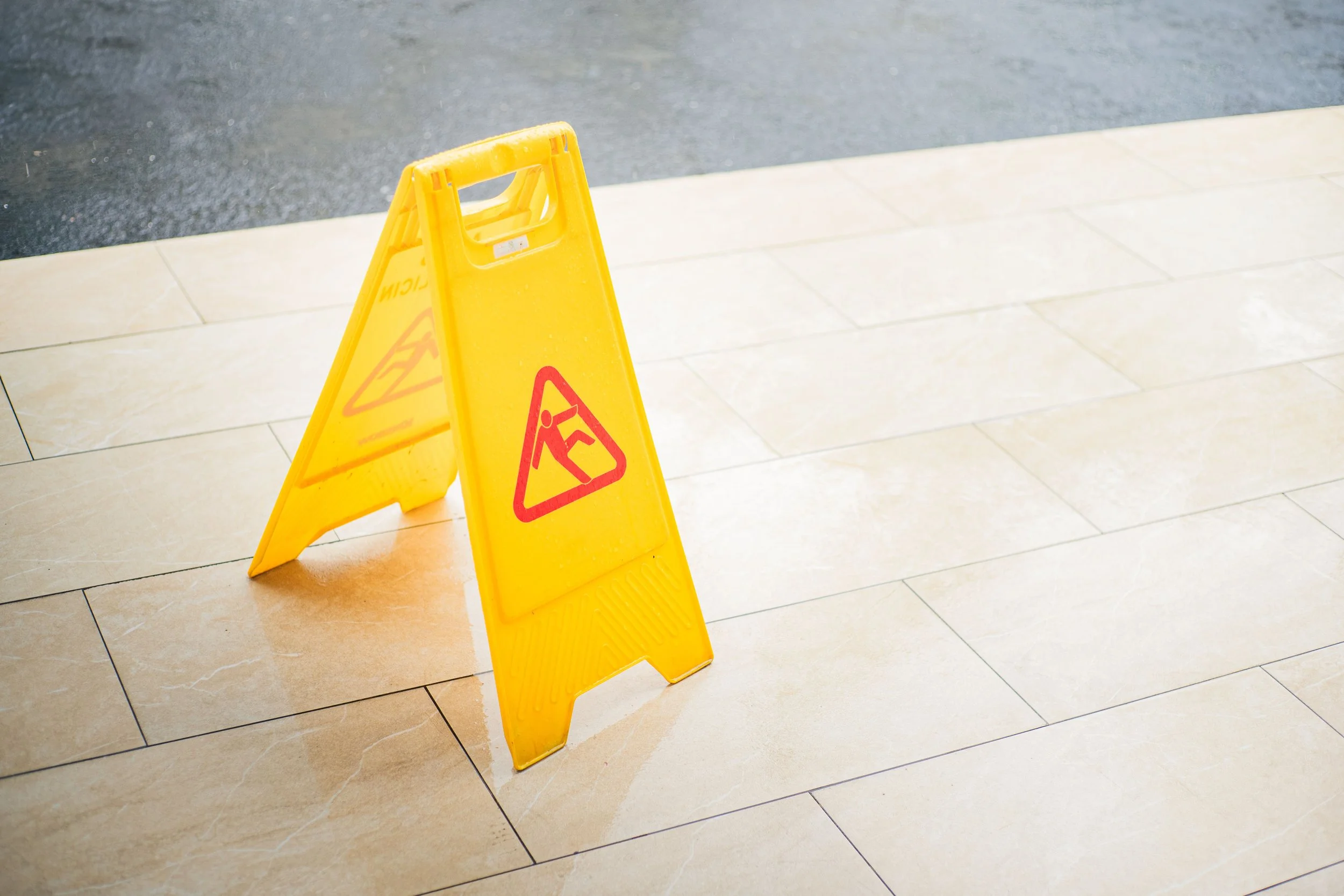
A fall can happen in seconds. One moment someone is walking through a store, parking lot, apartment building, or office, and the next they're on the ground trying to understand what happened.
But while the physical event is over almost immediately, the questions can continue for much longer.
Was there water on the floor? Was a stair broken? Did poor lighting hide a hazard? How long had the dangerous condition existed? Did anyone know about it? And perhaps most importantly, what injuries did the fall actually cause?
Those questions can become central after a slip and fall. The answers often depend on evidence that may disappear quickly, which is why understanding the condition that caused the fall can be just as important as documenting the injuries afterward.
What Caused the Person to Lose Their Footing?
The first question sounds simple: Why did the person fall? Sometimes the answer is obvious. A drink spilled across a grocery-store aisle may create a slippery surface. A broken stair can cause someone to lose their balance.
Other hazards are easier to miss. Uneven pavement, loose carpeting, potholes, debris, damaged flooring, missing or defective handrails, and poor lighting can all contribute to falls. Mission Personal Injury Lawyers identifies many of these conditions among common causes of fall accidents.
The exact location matters too. A small change in floor height might be difficult to notice in a dim hallway but obvious in bright daylight. Water near an entrance may create different questions depending on the weather and whether mats or warnings were present.
Identifying the hazard is the starting point because simply falling on someone else's property doesn't automatically establish that the property owner did something wrong.
Did the Property Owner Know About the Problem?
Finding a dangerous condition is only part of a premises liability investigation. Another important question is what the property owner or responsible party knew about it.
Sometimes there may be evidence of actual knowledge. An employee might have noticed a spill but failed to clean it, or a tenant may have previously complained about a broken stair.
Other cases involve what is often called constructive notice. At a high level, the question can involve whether a dangerous condition existed long enough or under circumstances where it reasonably should have been discovered.
Timing can therefore become extremely important. A spill that occurred seconds before someone fell creates a different situation from one that had remained untouched for a substantial period.
Inspection procedures, employee testimony, maintenance records, surveillance footage, and prior complaints may help establish what was known and when. The condition itself matters, but the timeline surrounding that condition can be equally important when determining whether negligence occurred.
Document the Condition Before It Changes
Many accident scenes don't remain unchanged for very long. A spill can be mopped up. Debris can be removed. A broken step can be repaired. A loose mat can be repositioned. Once that happens, it may become much harder to show exactly what the person encountered.
Photographs can preserve the scene. When possible, images showing both the specific hazard and the surrounding area can provide useful context. Witnesses may also matter. Someone nearby could have seen the fall, noticed the condition beforehand, or heard an employee discussing the problem.
Surveillance footage can be particularly valuable because it may show not only the fall but how long the hazard existed beforehand. Mission Personal Injury Lawyers notes that gathering evidence, interviewing witnesses, and reviewing safety information can be important parts of investigating these claims.
An incident report can create another contemporaneous record. The basic idea is simple: document the scene while it still looks like it did when the accident happened.
Injuries May Become Clearer After the Initial Shock
The first reaction after falling is often embarrassment or surprise. Someone may stand up quickly and assume they're fine. But the seriousness of an injury isn't always immediately obvious.
Falls can cause fractures, head and neck injuries, back injuries, concussions, soft-tissue injuries, and injuries involving the knees, hips, shoulders, or wrists. More severe falls can result in spinal cord or brain injuries.
Symptoms can also evolve after the initial event. Pain, swelling, stiffness, dizziness, headaches, or limited movement may become more noticeable after the immediate stress of the fall has passed. Appropriate medical evaluation can help identify injuries and determine what treatment is necessary.
Medical documentation may later become important if there is a dispute about what injuries resulted from the accident. Prior medical conditions and other possible causes may also need to be considered. The fact that someone was able to stand up afterward doesn't necessarily reveal the complete medical picture.
Conclusion
The fall itself may last only a moment. Figuring out why it happened can take considerably longer. A meaningful investigation looks beyond the fact that someone ended up on the ground.
What condition caused the fall? How long had it existed? Did the property owner or employees know about it, or should it reasonably have been discovered? Were there warnings? What evidence remains?
Those questions can become just as important as documenting the injury. Photographs, surveillance footage, witnesses, incident reports, maintenance information, and medical records can help reconstruct what happened after the physical scene has already changed.
That's why the minutes immediately following a fall can matter. The injury needs appropriate attention, but the condition that caused it may also need to be preserved before someone cleans, repairs, moves, or removes it. Once the hazard disappears, answering the questions surrounding the fall can become much harder.