Creating a dedicated space for physical well-being within your own four walls can be a shift in mindset. It moves you from "finding time" for the gym to "making space" for your wellness.
While heavy machinery and crowded weight rooms have their place, the discipline of Pilates offers a unique proposition: high-impact results with low-impact movements, often requiring minimal square footage.
Many Pilates exercises use only body weight. However, using specific pieces of equipment can significantly deepen your practice, challenge your muscles in new ways, and support your progress over time.
Let's look at 15 essentials for Pilates at home that can transform your living room into your personal Pilates studio, ensuring every session is both challenging and effective.
Main Types of Pilates Equipment for Home
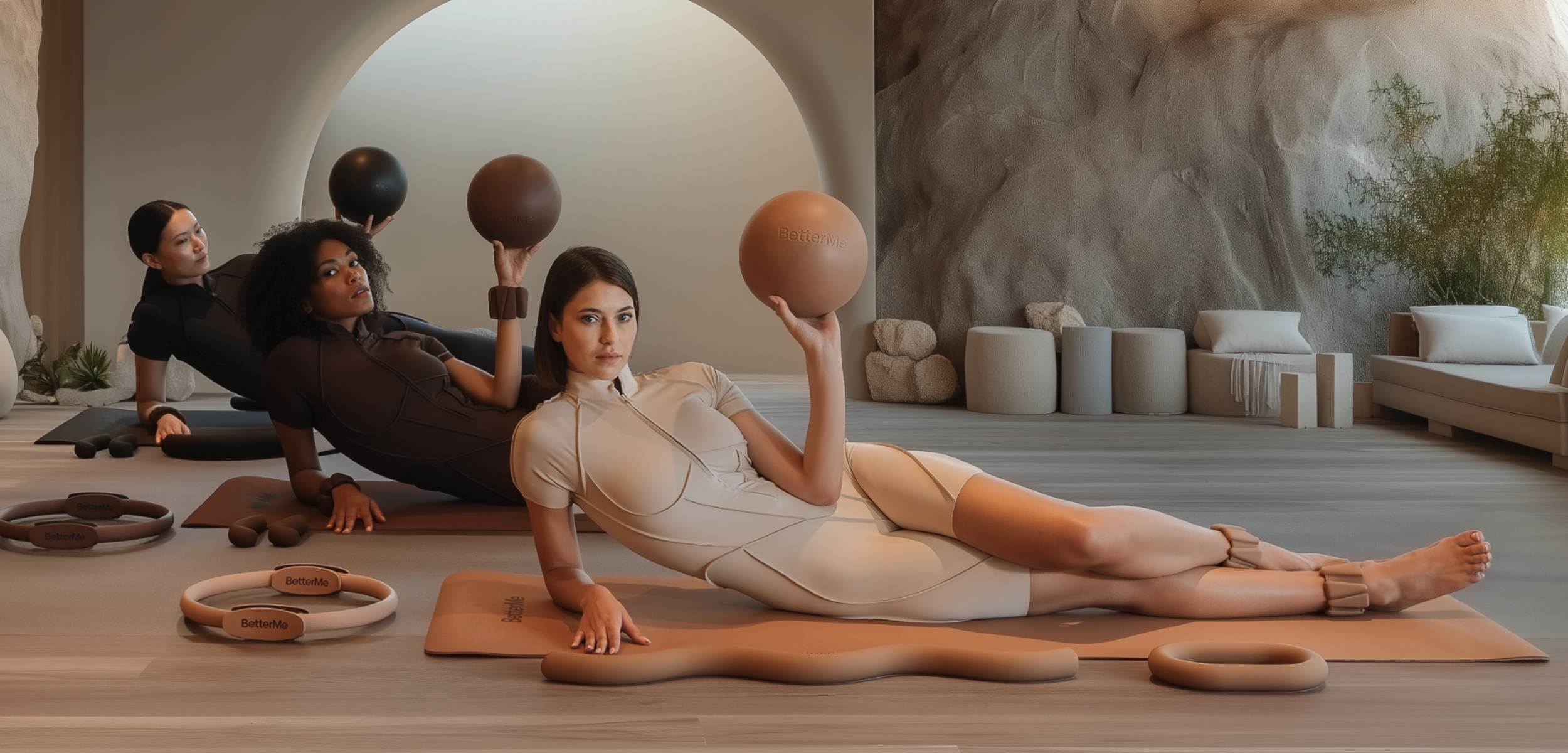
Thinking of having an efficient home Pilates setup? Here are the main types of beginner Pilates at-home equipment to consider.
Mat: A quality mat is the foundation of your practice. It should be thick enough—typically around 6-15mm—to cushion your back and joints during floor exercises.
Pilates Ring: Also known as a magic circle, this flexible ring has two pads on opposite sides. Squeezing it between your hands or thighs adds resistance to target and tone muscles in the upper and lower body.
Long Resistance Bands: These versatile elastic bands are excellent for mimicking the resistance provided by a Pilates reformer machine, adding a strength-training component to mat exercises.
Loop Bands: Shorter, closed-loop bands are ideal for activating and strengthening the glutes and hips, crucial for stability and power in Pilates movements.
Pilates Ball: This small, soft, inflatable ball is used to support the lower back, neck, or head. It can also be placed between the knees or ankles to engage the inner thighs and core.
Pilates Sliders: These small discs glide across the floor, challenging your stability and forcing your core to work harder to control movements like lunges and pikes.
Dumbbells: Light dumbbells, typically 1-3 pounds, can be incorporated to add a strength challenge to arm and shoulder exercises.
Foam Roller: Used for both exercises and recovery, a foam roller can challenge your balance or be used for self-myofascial release to relieve muscle tightness after a session.
Massage Ball: This firm ball is perfect for targeted muscle release, helping to work out knots in areas like the shoulders, back, and hips.
Pilates Socks: Grip socks are essential for safety, preventing your feet from slipping during standing exercises or on sliders, ensuring proper form and stability.
Weight Bands: These wearable weights for your ankles or wrists add a constant, low-level resistance, intensifying bodyweight movements and enhancing muscle toning.
Yoga Block: A supportive block can help modify poses by bringing the floor closer to you, supporting your hips in seated poses, or adding height for certain exercises.
Pilates Arch: This piece of equipment is designed to support the natural curve of the back, helping to decompress vertebrae and improve flexibility during backbends and stretches.
Balance Ball: A large, inflatable stability ball challenges your entire body, forcing your core muscles to fire continuously to maintain balance during exercises.
Balance Pods: These small, spiky domes are used to improve balance and proprioception. Standing on them during exercises activates the small stabilizing muscles in your feet and ankles.
If you're ready to start building your collection, you can explore Pilates at-home equipment — perfect for creating a complete home setup.
How Pilates At-Home Equipment Improves Well-being
Using Pilates equipment does more than just make the workout harder; it fundamentally changes the physiological response of your body.
Impact on Strength
While mat Pilates uses body weight, progress often slows if the challenge stays the same. Adding home Pilates equipment—such as resistance bands, a Pilates ring, or light dumbbells—creates extra resistance so your muscles have a clear reason to adapt. Over time, that can improve strength and endurance, especially through the core, hips, and glutes.
Impact on Flexibility
Flexibility improves best when you can hold a stretch with good alignment and steady breathing. Tools like straps, a Pilates arch, or a ball can support the body so you stay in position longer without compensating. For example, a strap during a hamstring stretch helps you keep a neutral pelvis, which makes the stretch feel more focused and controlled instead of pulling on your lower back.
Impact on Balance
Balance improves when your body learns to stay steady under small changes and shifts. Tools like a balance ball, foam roller, sliders, or balance pods create a slightly unstable surface, which forces you to control the movement instead of “coasting.” Over time, this improves coordination and stability in the ankles, hips, and core—useful both in workouts and everyday activities.
Setup and Equipment Selection Tips
Creating a dedicated space is just as important as the workout itself. Here is a systematic approach to setting up your beginner Pilates at-home equipment:
Measure Your Space: You need enough room to lie flat with arms extended overhead and legs extended fully. A 6x8 foot area is generally sufficient.
Start with the Foundation: Your first purchase must be a high-density mat. Without adequate spinal cushioning, exercises like "The Hundred" or "Teaser" become uncomfortable and potentially injurious.
Select Versatility Over Niche: If budget is a constraint, prioritize items with multiple uses. A set of resistance bands and a Pilates ball offer hundreds of exercise variations for a fraction of the cost of a reformer.
Check for Safety Ratings: Ensure balls and bands are "anti-burst" or "snap-resistant." Your equipment must be able to withstand the force you apply.
Control the Environment: Ensure your floor surface is not slippery. If using sliders, you need a smooth surface (wood/tile) or specific sliders made for carpet.
Common Mistakes and How to Avoid Them
Even with the best gear, technique errors can hinder progress. Here are common pitfalls to avoid.
● Over-relying on Equipment: The equipment should assist or challenge you, not do the work for you. For example, relying solely on the springs of a Pilates reformer at home to pull you back into position eliminates the eccentric muscle work.
Correction: Control the return phase of every movement; resist the equipment.
● Using Too Much Resistance: Heavier is not always better in Pilates. Using a band that is too thick can cause you to recruit dominant muscles (like the traps or quads) rather than the deep stabilizers.
Correction: Choose a resistance level that allows you to maintain perfect form and alignment throughout the entire rep range.
● Ignoring the Breath: Equipment adds complexity, which often causes beginners to hold their breath.
Correction: Inhale to prepare, and exhale on the exertion (the hardest part of the move).
● Lack of Consistency: Buying the gear doesn't equal doing the work.
Correction: Schedule your sessions like a medical appointment. Use your beginner Pilates at-home equipment 2-3 times per week to build the habit.
Building a home Pilates practice is an investment in your long-term functional wellness. By selecting the right tools—from the humble mat to the versatile resistance band—you create an environment where consistent, progressive training is possible.