
ACTIVE COAST TO RESORT EASE: HOW TO CHOOSE SWIMWEAR THAT MOVES WITH YOU

Vacation swimwear has a bigger job than it used to. A swimsuit might start the morning in the ocean, move to a paddleboard before lunch, dry off during a walk along the coast, then stay on underneath an oversized shirt for the rest of the afternoon.

That shift has made the best beach wardrobes feel increasingly close to athleisure: pieces still need to look good, but comfort, stretch and freedom of movement matter once the day gets going.

That balance is where BERLOOK's women's swimwear fits naturally. Alongside its more minimal bikinis and resort-ready textures, the collection includes cross-back straps, high-stretch fabrics, adjustable details and one-pieces with both regular- and long-torso sizing—details that make it easier to choose a suit for more than the pool chair.

Here are two ways to build a beach-day wardrobe around swimwear that can keep up.

1. ACTIVE COAST: CROSS-BACK DETAILS & TEXTURE

A morning by the water rarely stays completely still. There is the swim you planned, the walk you didn't, and occasionally the paddleboard someone convinces you to try after breakfast.

For days like these, start with the back of the swimsuit.

Crossed straps have a naturally sportier feel, but they can also become one of the most interesting parts of the design. They sit neatly across the shoulder blades while creating enough detail that the swimsuit still feels styled rather than purely functional.

Textured movement with the Dark Green Jacquard X Cross One-Piece Swimsuit: BERLOOK gives this deep-green one-piece a jacquard texture, contrast piping and an open cross-back that feels equally at home at a resort pool or walking down to the beach. The fabric is listed as high stretch, while the moderate-coverage bottom keeps the silhouette clean rather than overly athletic.

One especially useful detail is easy to miss in the photos: BERLOOK currently provides both regular- and long-torso measurements for the style. If one-pieces usually look perfect on the hanger but pull uncomfortably once you put them on, torso length is worth checking rather than automatically sizing up.

Style it with loose linen shorts, flat leather sandals and a woven beach bag for an easy coastal uniform. Once the swim is over, add an open white shirt and the one-piece does the work of a fitted bodysuit without requiring an outfit change.

DARK GREEN JACQUARD X CROSS ONE-PIECE SWIMSUIT | BERLOOK

If you prefer two pieces, the same idea works with a cross-back bikini.

The Blue Print O-Ring Cross Back Bikini Top uses a bright coastal print, slim crossed straps and a small ring detail at the front. BERLOOK lists it as high stretch with removable soft cups and 3/4-cup coverage. Customer feedback on the current product page also includes women mentioning that the top stayed secure while swimming—useful context when a swimsuit needs to do more than photograph well.

Pair it with its matching bottom for a full print moment, or break up the pattern with a solid navy or white bottom for a more relaxed look.

2. RESORT EASE: SEPARATES THAT LET YOU SET THE RULES

Not every beach day needs a sportier swimsuit. Sometimes the real luxury is simply wearing something comfortable enough that you stop thinking about it.

This is where separates become especially useful.

A bikini top and bottom do not have to solve the same fit problem. You can choose more structure through the bust while keeping the bottom minimal, or pair a triangle top with more coverage through the hips. And if your top and bottom naturally fall into different sizes, buying them separately avoids asking one size label to do two jobs.

BERLOOK's current bikinis collection leans into that mix-and-match idea, with triangle, underwire and cross-back tops sold alongside bottoms in different rises and coverage levels.

For a resort day, the styling can stay simple.

Take the Blue Print O-Ring top and add wide-leg white trousers, an unbuttoned linen shirt and a pair of sunglasses for lunch by the water. Later, lose the trousers, add the matching bikini bottom and you are back at the pool.

BLUE PRINT O-RING CROSS BACK BIKINI TOP | BERLOOK

The trick is not trying to make every swimsuit perform like athletic gear. It is choosing the details that make sense for the day.

If you know you will actually swim, look at how the straps connect and whether the top feels secure when you raise your arms.

If you love one-pieces but always feel them pulling through the body, check the torso measurement.

If you usually need different sizes above and below the waist, start with separates instead of trying to force a matching set.

And if the plan is simply a lounger, a book and something cold to drink, choose the beautiful suit. Vacation wardrobes are allowed to have fun.

The best swimwear works much like the best athleisure: it moves easily between the different versions of your day without making you think too hard about what you are wearing.

Explore BERLOOK's women's swimwear for one-pieces, textured styles and more active-inspired silhouettes, or browse its bikinis to build a mix-and-match combination around the fit and coverage you prefer.

FROM INDIVIDUAL COMPOUNDS TO BLENDS: THE BASICS OF PEPTIDE FORMULATION

Peptide research has evolved considerably over the past decade. Where laboratories once worked almost exclusively with single isolated compounds, there is now growing scientific interest in how multiple peptides interact when combined in formulated blends. This shift reflects a broader maturation in the field, moving from characterizing individual molecules in isolation to investigating how they behave together in more complex experimental systems.

Understanding the basics of peptide formulation, what drives the decision to combine compounds, what technical challenges blending introduces, and what researchers need to know about quality and documentation when working with multi-peptide preparations, is increasingly relevant for anyone working in this space.

PHOTO CREDIT | Unsplash/D koi

For researchers exploring blend formulations, sourcing decisions matter as much as they do for single compounds. Platforms where you can Buy Klow Peptide and similar blend products from documented, research-focused suppliers reflect the growing sophistication of the research peptide supply market in meeting this demand.

Why Researchers Move From Single Compounds to Blends

The simplest answer is that biology is rarely driven by a single signaling molecule acting in complete isolation. Physiological processes involve cascades, feedback loops, and parallel pathways where multiple signaling molecules act simultaneously or sequentially. Research designs that attempt to replicate or investigate these processes sometimes require multiple compounds present in the same experimental system at the same time.

There are also practical research rationales for blend formulations. When two peptides are known to act on different but functionally related targets, combining them allows researchers to examine potential additive, synergistic, or antagonistic interactions in a controlled experimental context. This kind of interaction research is not possible if each compound is always studied in strict isolation.

Convenience is a secondary but real consideration. A well-characterized, pre-formulated blend prepared to verified specifications reduces the number of preparation steps a researcher needs to perform, which in turn reduces variability introduced by individual weighing, reconstitution, and combination steps at the bench level.

The Scientific Logic Behind Peptide Pairing

Not all combinations of peptides make scientific sense. The rationale for pairing specific compounds in a research blend should be grounded in an understanding of their mechanisms of action, their receptor targets, and the biological questions being investigated.

Peptides that act on receptors in the same signaling network are natural candidates for combination research. If peptide A activates a receptor that initiates a signaling cascade, and peptide B acts on a downstream component of the same cascade, studying them together allows investigation of how upstream activation interacts with downstream modulation.

Similarly, peptides that act through complementary rather than redundant mechanisms provide interesting combination research subjects. When the mechanisms are truly parallel, combining them in appropriate experimental systems can reveal whether and how those mechanisms interact at the cellular or systemic level.

The scientific literature on peptide combinations remains far less developed than the literature on individual compounds. This is partly because combination research introduces additional complexity that makes interpretation more demanding. But it also represents a genuine frontier where careful experimental work can contribute meaningfully to knowledge that single-compound studies cannot access.

Formulation Chemistry: What Changes When You Blend

Moving from individual peptides to blended formulations introduces technical considerations that do not arise when working with single compounds. Each of these deserves careful attention in research contexts.

Compatibility Between Components

The most fundamental question in any blend formulation is whether the individual components are compatible with each other under the conditions of the formulation. Compatibility has several dimensions.

Chemical compatibility means that the peptides do not react with each other in ways that alter their structure or activity. Peptides can potentially interact through electrostatic interactions between charged residues, through disulfide bond formation if both contain cysteine residues, or through other chemical reactions that could modify one or both compounds in the blend.

Physical compatibility concerns whether the compounds remain properly dissolved or suspended in the same formulation matrix. Peptides with very different solubility profiles may be difficult to combine in a single aqueous preparation without one or both precipitating.

Stability compatibility considers whether the presence of one compound affects the degradation rate of another. Some compounds can catalyze or accelerate the degradation of other sensitive molecules in the same solution, reducing the effective concentration of active material over time.

pH and Buffer Considerations

The pH of the formulation matrix affects the solubility, charge state, and stability of each peptide component. Many peptides have pH-dependent solubility, meaning they dissolve readily at some pH values and poorly at others. Finding a pH that supports adequate solubility for all components of a blend simultaneously can require careful optimization.

Buffer composition also matters. Some buffer components interact with peptides in ways that affect stability or analytical measurements. Phosphate, acetate, and histidine-based buffers are commonly used in peptide formulations, but the best choice depends on the specific compounds involved and the intended storage and use conditions.

Quality Documentation for Blend Formulations

The quality documentation requirements for peptide blends are more complex than for single compounds, and researchers should expect this complexity to be reflected in what a reputable supplier provides.

For a single-compound peptide, the certificate of analysis confirms identity and purity for one target molecule. For a blend, the documentation needs to account for each component individually as well as the final formulated product.

Ideally, documentation for a research-grade peptide blend should include identity and purity confirmation for each component before blending, the nominal ratio or concentration of each component in the final formulation, analytical verification of the final blend composition, stability data for the formulated product under recommended storage conditions, and lot-level traceability that connects the final blend to the analytical records for each individual component.

This level of documentation is the standard that serious researchers should expect and demand. Blends supplied without component-level analytical data leave significant uncertainty about whether the observed ratio and quality in the final product reflect what was intended.

For researchers evaluating specific blend products designed for particular research applications, seeing how documentation is structured and what information is provided upfront is part of the evaluation process. When you Buy Klow Peptide or any comparable blend product from a quality-focused research supplier, the documentation accompanying the product should give you a clear picture of what each component is and how the formulation was characterized.

Reconstitution and Handling of Blend Formulations

Most research-grade peptide blends are supplied in lyophilized form, meaning they have been freeze-dried as a combined preparation rather than as separate powders. This approach simplifies the researcher's workflow but requires that the lyophilization process was validated for the specific blend composition.

Reconstitution of a lyophilized blend should follow the supplier's recommendations closely. The choice of reconstitution solvent, the volume used, and the reconstitution technique all affect how completely the material dissolves and how stable the resulting solution is.

Some peptide blends may require specific reconstitution conditions to bring all components into solution fully. If the recommended reconstitution approach differs from what you would use for one of the individual components in isolation, follow the blend-specific guidance rather than applying assumptions from your experience with single-compound preparations.

Once reconstituted, blend solutions should generally be stored at the lower end of the recommended temperature range and used within the defined stability window. Multi-component systems can have different stability profiles than individual compounds, and the stability window for the blend should be treated as the binding constraint regardless of what individual component stability data might suggest.

Analytical Challenges in Blend Research

Working with blends introduces analytical challenges that researchers need to plan for when designing their experimental protocols.

Quantifying each component of a blend in solution requires analytical methods capable of resolving the individual compounds. Reverse-phase HPLC can often separate peptides with different sequences, but the resolution may be insufficient if the components have very similar physical properties. Developing validated analytical methods for quantifying each component in the presence of the others is an important step before beginning research work with a new blend formulation.

Mass spectrometry can help by providing molecular weight information that distinguishes individual components even when they are not fully resolved chromatographically. Combined LC-MS approaches, where the mass spectrometer serves as a highly selective detector following chromatographic separation, are often the most powerful analytical tools for blend characterization and quality verification.

Practical Tips for Researchers New to Blend Formulations

Start with clear scientific rationale. The decision to use a blend rather than individual compounds should be driven by a specific research question about interaction or combined signaling, not simply by convenience. Establishing that rationale upfront makes experimental design and result interpretation clearer.

Request complete documentation before ordering. For any blend product, ask specifically for component-level analytical data and final blend composition verification. Suppliers who can provide this information promptly and clearly are demonstrating quality systems appropriate for research supply.

Run initial characterization experiments before committing to a large-scale study. Understanding how a specific blend behaves in your experimental system, including how it reconstitutes, how stable it is under your storage conditions, and how it performs in your assays, is valuable information to develop before investing in extensive experimental work.

Final Thoughts

Peptide blend formulations represent a scientifically meaningful extension of single-compound peptide research, enabling investigation of interactions and combined effects that are not accessible when compounds are always studied in isolation. The move from individual peptides to formulated blends introduces real formulation chemistry challenges and more demanding quality documentation requirements, but it also opens research questions that reflect the genuine complexity of biological signaling systems.

Approaching blend research with the same rigor applied to single-compound work, including careful attention to sourcing quality, documentation standards, and experimental design, positions researchers to generate results that contribute meaningfully to the scientific literature in this developing area.

Disclaimer: All peptides and blend formulations referenced in this article are intended strictly for laboratory and scientific research purposes only. These products are not approved for human consumption, self-administration, or any application outside of formally regulated research environments. This content is purely educational in nature and does not constitute medical advice, treatment recommendations, or endorsement of any specific use. All researchers must ensure full compliance with applicable institutional guidelines, regional regulations, and national laws when procuring, storing, and handling research compounds.

HOW TO TALK TO YOUR TEEN ABOUT GETTING BRACES

Teen anxiety about braces often stems from uncertainty and appearance changes. The pain and the look of the braces do not appeal to them. This is when parental support is crucial. Positive encouragement can build a smooth experience for your child.

Having a talk about the process can help mentally prepare the child. In this guide, we will share some communication techniques about braces for teens. You will learn to boost your child’s confidence in a healthy way.

PHOTO CREDIT | Pexels/Cottonbro Studio

When Is the Best Time to Talk to Your Teen About Braces?

Teen orthodontic treatment usually begins at the age of 10 to 14. During this time, their permanent teeth have fully emerged. Yet, their jaw and other structures are still developing. It is the prime time for realignment.

These are some signs that suggest a dental visit. The child may need braces.

  • Physical appearance
    Noticeable teeth misalignment will not go away as they age. Any visible alignment issues should be assessed by the orthodontist.

  • Functionality problems
    If your child has trouble chewing or often bites their tongue or lips, alignment issues might be the cause. Unaddressed problems can affect their speech ability.

  • Pain
    Jaw/teeth pain should be examined as soon as possible. It can be caused by the growing jaw that keeps pushing against the teeth.

How Can Parents Address a Teen's Fear of Getting Braces?

In explaining braces for teenagers, try these techniques. 

  • Long-term benefits
    Aligned teeth can improve oral health. Provide a bright vision that can encourage the teen to receive the treatment.

  • Normalize the experience
    Getting braces is nothing to be ashamed of. It is a common procedure that many teenagers receive.

  • Timing advantage
    Explain why realignment is often easier at their age. Starting the process sooner may mean a shorter overall timeframe.

  • Timeline expectations
    Inform them about timeline expectations. Some teens are not against getting braces. They are simply worried about the uncertainty.

How Can Parents Give Their Teen More Control Over the Decision?

Offer your child a chance to be involved. Give them a few options. A sense of autonomy can help them open up to the idea.

  • Choose the start time
    Is your kid concerned about showing up at school with braces? How about letting them choose a start time during term breaks? 

  • Choose the treatment options
    Based on the orthodontist's advice, let your child select the treatment options. Usually, there are a few modern alternatives to choose from. 

  • Choose the provider
    The clinic you prefer may not be your child’s first choice. They often have their own preference. Let them choose their orthodontist if possible.

How Can Parents Prepare Their Teen for Life With Braces?

If braces are necessary for life, parents should:

  • Explain clearly the reasons for this

  • Prepare home care supplies to meet the needs

  • Be honest about realistic expectations

  • Provide emotional support

  • See if diet changes are needed

The teen should not feel that their life is defined by the braces. The best thing parents can do is listen to the child’s needs. Making accommodations can help them live a normal life with braces. 

What Should Parents Avoid Saying About Braces?

Teen anxiety about braces can be severe. Occasionally, parents may feel frustrated and say things they don’t mean. Here is a reminder of some things parents should avoid during a discussion.

  • Avoid using negatives
    Don’t describe potential problems by using negative phrasing. For example, don’t say that the teen will get bullied or that they will not find a prom date if they don’t fix their teeth. 

  • Avoid misleading them with expectations
    Never lie about the potential results and timeline. Overselling the promise can be devastating when the truth comes out.

  • Avoid arguing
    Compose yourself even if the discussion is getting heated. Debate on the topic calmly. Don’t argue intensely. They will likely be more against the idea after an unpleasant argument.

  • Avoid belittling the child
    Don’t say things like “Many people do it. You are weak not to.” Belittling the child can hurt their self-esteem in the long run. 

What Questions Should Teens Ask the Orthodontist?

During the assessment, you can ask the orthodontist a few questions. A responsible provider like Smiles + Grins will always answer every question clearly.

  • What are the realistic expectations (results/timeline)?

  • What options are suitable for me?

  • Can I make adjustments if I’m not happy with the progress?

  • What happens if I choose to do nothing?

  • How do I get support for emergencies?

In conclusion 

PHOTO CREDIT | Pexels/Cottonbro Studio

Teen orthodontic treatment does not have to be scary. With the right provider, the process can be comfortable and efficient. Speak to your clinic about your needs. Work with your child together through the journey.

ALO YOGA UNVEILS BAMBOO GREEN: A GROUNDED NEW SHADE FOR THE SEASON OF RESET

There is a kind of green that does not shout. It does not compete with neon or chase the candy-bright palettes of high summer. Bamboo Green arrives quietly, like the first cool morning after a long stretch of heat — and it stays. Alo Yoga’s newest colorway draws from the stillness of bamboo groves: a muted, earthy green with grey undertones that keep it grounded, never garish. It is the kind of shade that looks intentional without trying too hard, and it moves seamlessly from the mat to the street without announcing the transition.

Born from a different kind of green

Alo Yoga has always carried “green” in more than one sense. The brand name itself stands for Air, Land, Ocean — three natural elements that anchor its commitment to ethical production and environmental awareness. Bamboo Green extends that philosophy into color. The hue takes its cue from the plant itself: resilient, fast-growing, and quietly adaptive. It is a green that feels less like a trend and more like a return to something essential. In a market flooded with seasonal color drops that burn bright and fade fast, Bamboo Green offers a slower, steadier kind of relevance.

PHOTO CREDIT | Alo Yoga

A palette built for real life, not just workouts

The Bamboo Green collection spans 37 products across women’s and unisex styles, covering the full arc of an active day. Core pieces include the Airlift Suit Up Bra and Airlift Lotus Bra, both cut from Alo’s signature Airlift fabric — a micro-performance double-knit with a subtle sheen that sculpts and supports without feeling restrictive. The Match Point Short and Wild Thing Bra bring the same color into lighter, more breathable silhouettes for warmer sessions. For layering, the Socialite Shacket offers a relaxed, oversized structure that works as easily over leggings as it does over a dress. The Aspire Tank in Bamboo Green/White introduces a clean two-tone contrast for those who want the shade without committing to a full monochrome look.

What ties these pieces together is not just the color — it is the fabric philosophy. Airlift is composed of 84% polyester and 16 elastane, delivering four-way stretch that recovers quickly and holds its shape through repeated wear. The fabric is moisture-wicking and quick-drying, designed to move sweat away from the skin during intense training while staying breathable enough for everyday wear. In Bamboo Green, the performance technology reads less like gym gear and more like a considered wardrobe choice.

Studio-to-street, without the switch

Alo Yoga has built its identity around the idea of “Studio-to-Street” — clothing that serves the practice and then keeps going. Bamboo Green makes that transition effortless. The Suit Up Trouser in this shade, cut from a lightweight stretch fabric with a boxer-style waistband, moves from a morning flow to a coffee meeting without a costume change. The Accolade Straight Leg Sweatpant brings the same color into a softer, street-ready silhouette with a chrome Alo logo detail. Paired with the Cropped Mountain Peak Full-Zip Hoodie, the full look lands somewhere between athletic and architectural — polished enough for errands, relaxed enough for recovery.

For those who prefer a more structured layer, the Socialite Shacket in Bamboo Green adds a tailored edge to the collection. Its oversized fit and clean lines make it an easy throw-on over a sports bra and leggings, or layered over a slip dress for something less predictable. This is the kind of piece that proves color can be versatile when it is chosen with intention.

PHOTO CREDIT | Alo Yoga

Why this green, and why now

Most activewear color stories fall into two camps: the safe neutrals (black, grey, white) and the seasonal pops (coral, lilac, electric blue). Bamboo Green sits deliberately between them. It has the depth of a neutral but the character of a statement. The grey undertones make it flattering across skin tones, while the muted saturation keeps it from feeling juvenile. It pairs naturally with black, cream, and camel — the building blocks of a functional wardrobe — but also holds its own against denim, leather, and knit textures. In a season that often leans into either austerity or excess, Bamboo Green offers something in between: calm, grounded, and quietly confident.

The collection is available now on Alo Yoga’s new arrivals page, with select pieces marked as limited editions. For those building a wardrobe that works as hard as they do — and looks like it was chosen, not defaulted into — Bamboo Green is the shade worth starting with.

Explore the Bamboo Green collection at aloyoga.com and find your next everyday essential.

CAPRI CORE TO RESORT GLAMOUR: HOW TO STYLE BLUE SWIMWEAR WITH SAMIOL'S SUMMER EDIT

From Mediterranean holiday feeds to curated Pinterest boards, ocean-inspired blue is this season’s hero shade. Driven by social media trends like #CapriCore—which channels retro Italian riviera style—and #ResortGlamour, which embraces "swim-to-street" dressing, blue has become the go-to shade for elevated vacation style. 

That "swim-to-street" transition is where SAMIOL’s Blue Swimsuits Collection really shines. Instead of basic, single-season beachwear, SAMIOL focuses on tactile depth and day-to-night flexibility. From saturated royal blues to calming ocean tones, each piece incorporates unique tactile details—including shimmering lurex fabric, lightweight sheer mesh, plush terry cloth, and ruffle-trimmed or backless cuts. The result is a lineup of supportive tankinis that easily double as sleek bodysuits once you step off the beach.

Here is how to style SAMIOL’s key pieces to bring these two trending vacation aesthetics to life.

1. Capri Core: Retro Textures & Coastal Nostalgia

Capri Core is all about breezy, low-maintenance Italian elegance—think sun-drenched cliffside towns, lemon groves, and slow mornings by the water. To pull this off, focus on tactile, vintage-inspired fabrics.

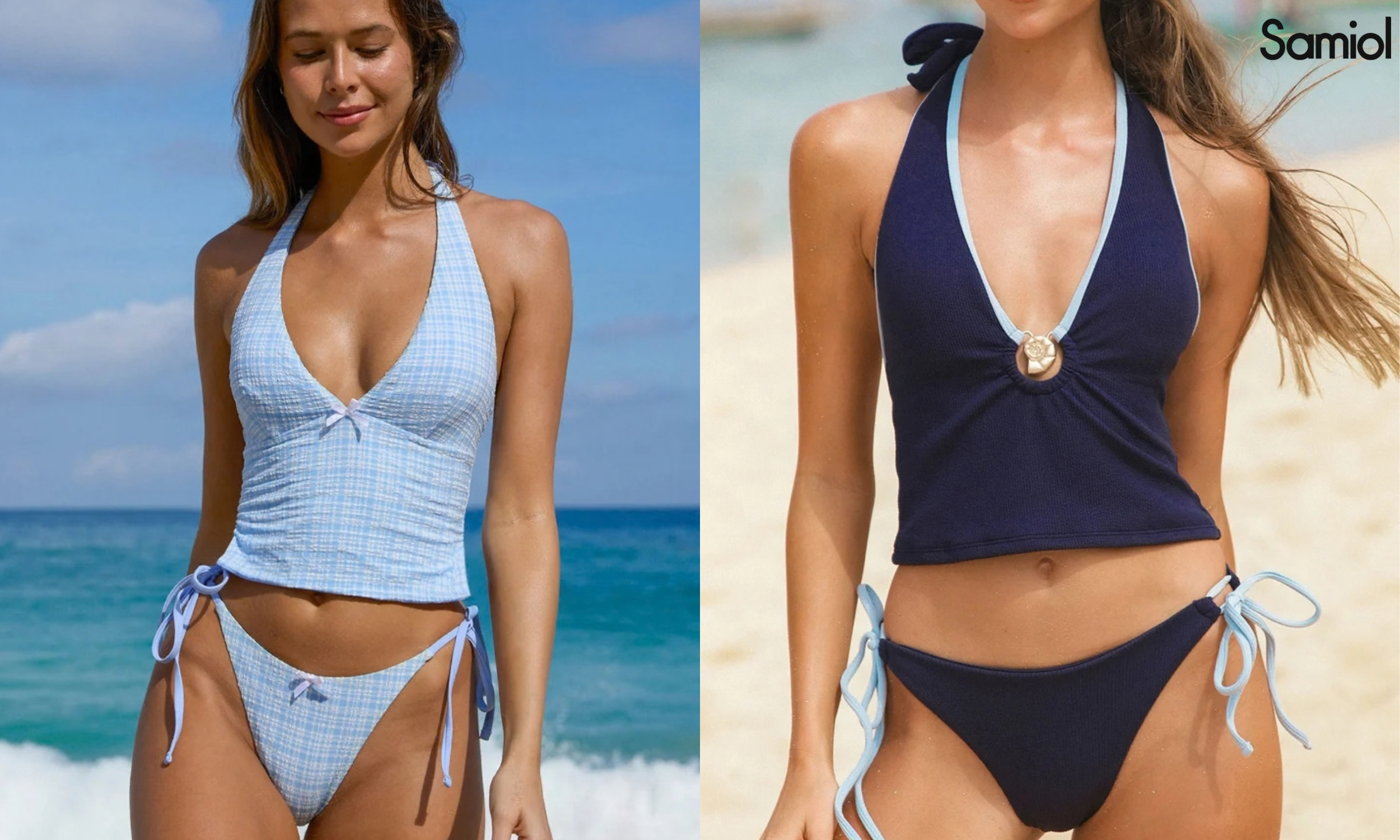
Gingham nostalgia with the Blue Knitted Plaid Tankini Set: Crafted with a cozy, textured knit plaid pattern, this set brings an unmistakable 1960s seaside charm. Style it by throwing an oversized, unbuttoned white linen shirt over top, paired with handcrafted woven slides and dark sunglasses for an afternoon sipping an iced espresso at a cliffside café.

Coastal charm with the Blue Contrast Shell Tankini Set: Accented with delicate contrast shell details along the edges, this tankini combines nautical minimalism with subtle seaside elegance. Pair the tankini top with high-waisted denim shorts, a wide-brim straw hat, and woven sandals for a breezy morning stroll along the coast.

PHOTO CREDIT | Samiol

2. Resort Glamour: Sunset Shimmer & Evening Silhouettes

As late afternoon melts into golden hour, poolside dressing turns significantly sleeker. The trick dominating social feeds right now is treating high-design tankini tops as fitted bodysuits—letting you step straight from a sunbed to sunset cocktails without a trip back to your room. 

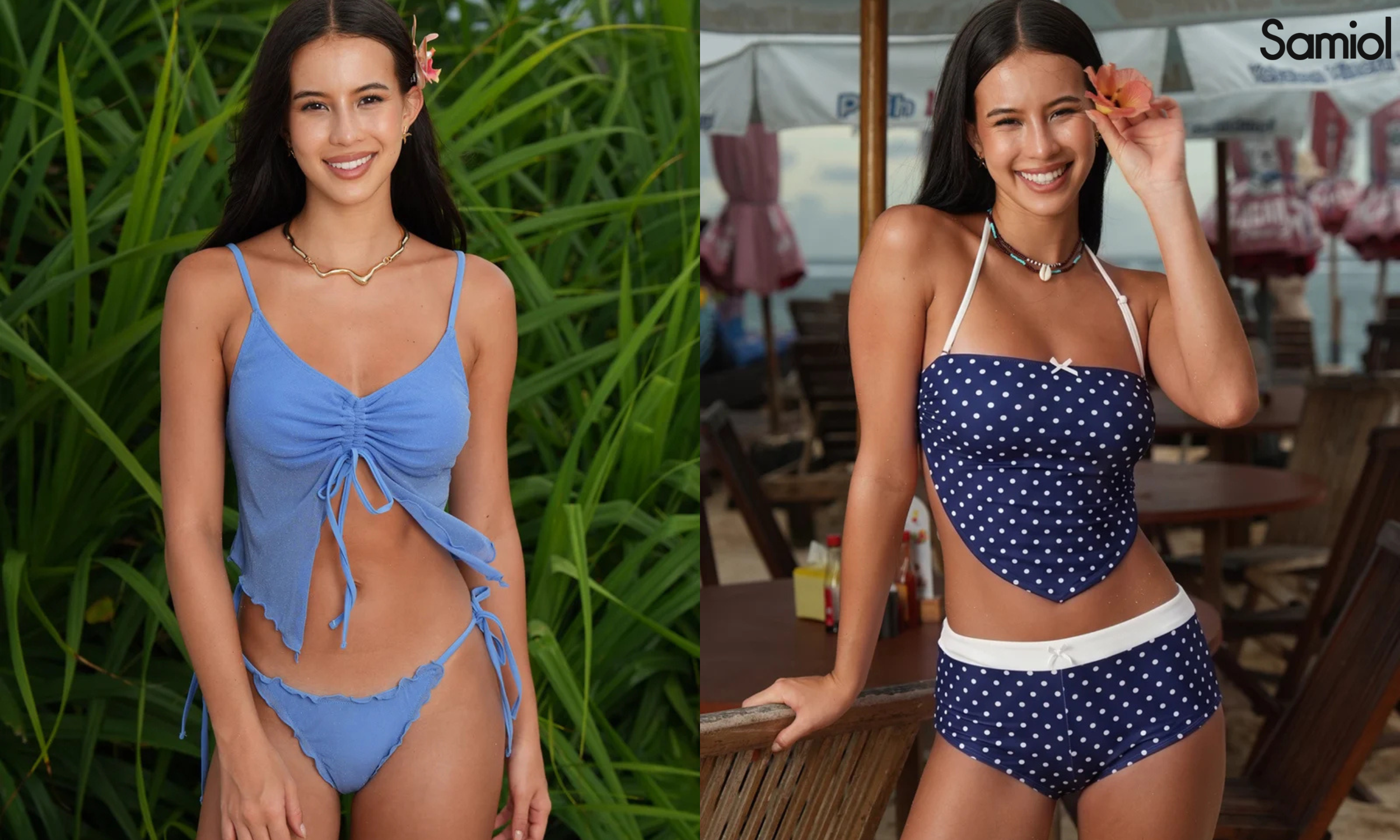
Golden-Hour shimmer with the Blue Lurex Wave Cut Tankini Set: SAMIOL weaves silver lurex metallic threads into knitted nylon, creating a subtle glitter that catches the warm sunset light along its scalloped wave edges. Style this top as a fitted bodysuit by tucking it into high-waisted, flowing silk trousers, complete with chunky gold hoops and metallic heels for rooftop cocktails.

Evening drama with the Royal Blue Polka Dot Backless Tankini Set: Drenched in a rich, jewel-toned royal blue with playful dot accents, this piece stands out with its striking low-back cut. Tuck it into a sweeping white maxi skirt to highlight the open back, layer a few gold bangles at your wrist, and you're ready for an open-air dinner by the beach.

PHOTO CREDIT | Samiol’s

The secret to a good holiday wardrobe is versatility, and blue swimwear makes that ridiculously easy. While blue is an unbeatable anchor for coastal trips, SAMIOL’s broader collection brings that same swim-to-street approach across plenty of other shades and silhouettes—taking you effortlessly from morning dips to candlelit dinners.

Begin curating your getaway wardrobe with the Blue Swimsuits Collection, or explore the full bathing suits at SAMIOL.