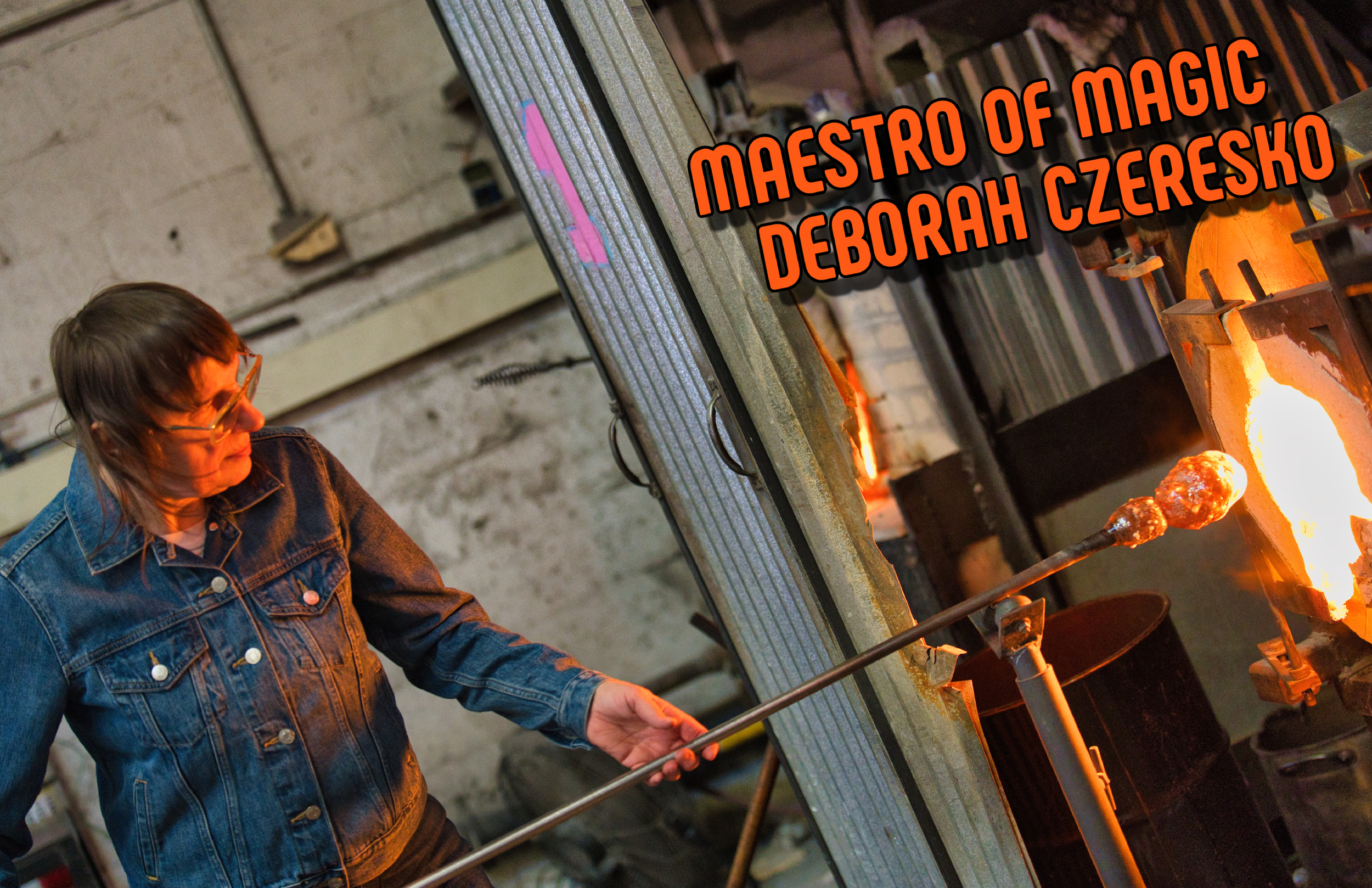

We spent an afternoon with Deborah Czeresko at Brooklyn Glass making three of her acclaimed and well-sought after Forgotten Potatoes with her, and her assistant Em. An acclaimed NYC-based artist and designer, Deborah is best known for her work with glass. She won the inaugural season of Netflix’s Blown Away glass competition show in 2019, where contestants compete in glassblowing challenges for prizes and the title of champion. Her work challenges societal norms with elegant, sophisticated and often whimsical themes rooted in gender and feminism. Her work has been shown in Corning Museum of Glass and the Smithsonian American Art Museum.
We love how she is such a deep thinker and super creative in speaking is art and metaphor. An extremely thoughtful and determined creative, we were honored to spend working time together to truly embrace the elegant fierce fragility that glass blowing presents at this top level. It was truly exciting to see her in action and hear her stories about past, present and future projects.
We first met her and her lovely partner, Three, on the eve of our January Cover drop, where we enjoyed Diageo’s legendary Burn’s Supper Night in NYC together, complete with Haggis, Poetry & Song, Bagpipes, and a medley of favorite Scottish Whiskey’s Johnnie Walker Blue Label, Oban Single Malt, Buchanan’s Blended Scotch Whiskey, and more.
ATHLEISURE MAG: You said glass was your first love, what were those first moments for you?
DEBORAH CZERESKO: It felt like a real true love. Like when you just are instantly attracted to something. It’s sort of fourth dimensional on some undefinable plane what you’re feeling, this kind of attraction, because it combines all the things you don’t know about yourself necessarily at that time. Like when I was younger and why was this material for me? It seemed kind of mystical and magical [and] what I didn’t know is the intelligence that I had in connecting to it in a physical way and in a conceptual way. I mean, now I can intellectualize it, but then I was just instinct-driven.
AM: And you knew it off the bat or within, say the first month - or looking back now, you’re saying that?
DC: Oh no. The moment I saw the glass, hot glass, I knew this was for me. So, first of all, you’re sculpting a fluid. That’s not like sculpting any other material. The stuff is flowing… [i]t’s a weird way to think that you’re actually sculpting a liquid. It’s the weirdness of how you sculpt this and the weirdness of the material itself. The material seems otherworldly when it’s hot, so it’s like lava. I was really attracted to the fact that this stuff seems so atypical and not stereotypical as a medium, really. So it definitely feels magical.
AM: So what does glass allow you to say that other materials wouldn’t let you do?
DC: Well, I touched on the fluidity, and also it’s transparency. So that’s something you can’t find in that many materials. So anything having to do with transparency and fluidity and this moving from different states in this particular way, in the middle of kind of a binary - it’s not soft and it’s not hard - it’s a fluid. So it’s constantly moving and even in its perceived state, when it’s cold it’s called a super cooled liquid, so I think you can say anything with glass they can say with any other material, but with glass I think the fluidity, and it inherently brings fragility on one side and then fierceness on the other.
And then at some point it becomes permanent. So when you’re working on it you’re able to go from A to B, and then a number of stops, and then you’re in control and you’re changing things. But at some point you lose control, right? At some point it’s beyond adapting, like after placing it in the annealer. The minute it’s in the annealer, you can’t then take the glasswork and put it back in the fire and remold it again right, so at some point you lose control.
I would say if we were having a dialogue with this material, it’s more like speaking this material’s language. It’s not going to speak our language, it’s not human, and when you can’t be receptive enough to learn about this material as it is [ultimately] going to take control. It’s going to dominate as dominant material, and that’s one thing about it in its property. It doesn’t look that way, it’s so demure in a way when you just look at a glass thing like a huge hunk of 100 pound glass could look like an enormous ghost, but it’s this massive thing that has these strengths you can’t even see and it’s just demanding that you sort it in a soft way to to be at one with it, rather than collaborate withn it.


AM: So how do you approach a project? What are some of the steps you take initially? Generally what do major project timelines look like?
DC: For my own artwork project or one initiated by a prompt of some sort, like as in the case of the large piece I did for the public school called “Everybody’s Gotta Eat,” in that case, I was told where the piece would be going. So it’s going to a public school for grades 1-6 outside of the school cafeteria. And so, the other criterion was to be significant and relevant for 100 years, and immediately that’s very intimidating. How could anything I say or do be relevant for 100 years, when the world is changing so rapidly at this point? I don’t know what demographic of person is going to be there, or even if the school is going to be a public school for that long. Let’s assume it is, so then I have to fit within those boundaries, but that’s a pretty open criteria. So I start thinking about the dialogue and the vernacular. I’ve started to create with my own work and how that can fit into that parameter. In that case, I submitted an initial idea and was asked to modify that idea because they really wanted the idea to be primarily glass. I submitted an idea that had a lot of metal in it because the project was so large and had to take up so much space. And glass is rather expensive, well so is metal, but I tried to occupy the space in other ways than just glass objects. So I started to think in terms of those limitations, and also financial in that situation. So that’s a commissioned piece.
Now, in the case of my own imagination, without any limits, I’m thinking about what I’m going to make all the time. I never am not thinking about those ideas and how what I want to put forward conceptually can be connected to some kind of form. And in recent years, I’ve been doing realistic forms, like eggs, for example, I’ve become synonymous with the egg. What kind of symbolism does that have? Is it enough to just put that egg out there? Do I have to do some kind of action to the egg? And so, as I’m going through the world, that’s how I get my creative ideas. That’s when I’m in the most, I think, creative mindset. I’m just influenced by New York. I’m in New York. It’s so beautiful and filled with art, like we walk down the street and we see graffiti and we see shoppers putting their potato chips in designer ways in their windows and entire shops making beautiful installations with their tires and hubcaps. I just feel like that’s part of me too, like my how I live in New York as that’s my world. So I try to do the similar things with the glass, like as if I were a storefront in New York with food. I try to tell my story here or what I think is relevant. I’m more like a miner. I’m mining for things constantly around me.
So you kind of have that page open, and it’s kind of like a piece of your personality where you’re thinking of ways for storytelling and expression that can always happen through this medium.
It just feels good so like being in that zone, I mean when I really connect, I really feel like I have an idea that is meaningful and just running on all cylinders, that’s when I feel the best, honestly.


AM: Oh, that’s cool. How often would you say that has happened?
DC: I don’t know. That’s more rare. It’s like to really nail it. I think the piece that would be the most iconic piece for me would be the Meat Chandelier that’s in the Corning Museum of Glass. I feel like I nailed it there. Sometimes that gets in the way of finishing a piece though, because once I already feel like I did it, then the assemblage becomes the hardest part, because then the most fun part of thinking I nailed it is over. So now it’s an aesthetic and a construction problem, rather than a conceptual problem. And that’s a different energy process. And it’s more like vacuuming. You have to make sure we’re cleaning the dishes. You have to make sure how to build something. It’s a different kind of energy than creative energy, I think with the installations because there’s a lot of other problems to solve, which aren’t right. The fun icing on the cake part.
AM: So what part would you say is the most fun? Is it thinking of it, making it, or having it up where people can enjoy it?
DC: I think on both ends of the spectrum here, like having it up and having people enjoy it is really satisfying to know that it’s done. And if I get to the point where I’ve actually thought of something, I think I like to have nailed it. That’s the most satisfying. The making part, it’s not as satisfying as those two things, honestly.
AM: Let’s talk about making it. So there, I was with you and your assistant Em making three Forgotten Potatoes at Brooklyn Glass, and there’s a lot to it in setting it up, making it, and constantly working and re-working it. There’s a lot of physical movement. So do you stretch before you start and do you work out certain areas to be more inclined to doing that? Tell me about the athleticism behind it, and also you started out wanting to be an athlete?
DC: I think that was one of the things that clicked for me in being attracted to glass. I wanted to be in a physical medium and I wanted to be in a creative medium. I wanted to express myself through my body, but not as a dancer. So, because that is something that was very intimidating to me, like rhythm and dancing, but I knew I was very physical. What material is going to incorporate that aspect of me is something I was asking without asking. I would say I wasn’t as conscious of it as I am now, but it’s obvious now why I was really attracted to this material. So challenging! It’s just like a feeling that you can’t get anywhere else really to work with glass in a variety of ways.
So [about] the athleticism, I was in high school sports and college sports, and it’s interesting to have an equal part athleticism and creativity with what you are going to do with that and how it is going to manifest. What is that going to make you in your life, and so I guess I found it by mistake. So I do prep and I make sure my body is in condition to work. So I work out in a gym doing strength training. Strength training is the best thing for prepping for this type of activity. I mean, glass can be easy physically, but it depends what you’re really going for here. If you’re doing a large production and making a thousand pieces in a day, that’s going to be physical in one way, versus a really large piece that weighs like 50 pounds. It’s going to be physical in a different way. Or you could just be a hobbyist and just make one thing a day and not really need to prep your body at all. But I don’t work every day. So I don’t want to go in there after not working and not be conditioned or ready to go. So it involves a lot, especially in the heat.


AM: So what gym do you workout in?
DC: I just recently moved to Crunch South Slope. It’s in Brooklyn, two blocks from the studio I’ve been training with a friend of mine, one of my people I work with to make glass. His name’s Alex Kruger. He’s a trainer at Crunch. It’s really cool because how often you get a trainer that’s also a glassblower, so it’s a pretty special situation right - he knows exactly what touch points help you and how I can do the workout and still be functional the next day. We’re doing a lot of higher reps.
AM: What kind of music do you listen to in the studio? Today we heard a lot of Buena Vista Social Club, which we absolutely love! So I was very happy. So what kind of music?
DC: I do like dance disco. I like Purple Disco Machine. They’re good. Groovy. Anything that goes well in hot weather actually does work well in the hot shop. Something with good vibes, something just open. Having good music, I think, is important doing art. I’m also influenced by my studio mate who’s over there. He’s Colombian, and so he does a lot of Latin beats and I like Celia Cruz, that came with that. I think it’s just such a lovely rhythm to work in glass with like and some people come in and try to play things like heavy metal and what not, but it doesn’t really go. It makes the time pass much slower, when you don’t have a good rhythm going.
AM: So what are some of the works you would say you’re most well known for?
DC: I would say there’s three. The one that sort of put me on the map, I think, as an artist was the Meat Chandelier, which is in the Corning Museum Collection. And that started my dialogue with using food and consumables and everyday objects as kind of a vernacular that I talk in with these objects. And that one was specifically sort of a critique of the hot shop that we work in and the patriarchy in general, and this patriarchal world of trying to enter in as somebody other than someone of the patriarchy. So it was a play [on that]. I always like to put a little humor in my work. So I see both sides of this coin on this. Like so many people have helped me of all genders, and so many people have hated me of all genders. So I’m kind of in the middle, but it’s a place where physicality matters and typically people working larger pieces are guys, so it by it’s very nature and we’re talking here specifically, about sculpting glass, not in factories and production in those situations, it’s almost all men.
So, like when I went to Italy, there are no women working on the pipe. By pipe, I mean blowpipe. There’s maybe an assistant helping somebody, but that is really still separated as far as genders go and glass making, outside of the studio glass movement of America and other countries. So this is an art scene, which is different, but it still has that aspect to it. Who gets the jobs? It tends to be the guys, whatever. It’s better in my world because I’m an artist and it’s an art world, but I’m also speaking about the world in general in my work. So that is real.
AM: So what are a couple of the other pieces you would say you’re most well-known for?
DC: Another piece would be the piece I just recently finished last year, which was “Everybody’s Got To Eat,” that is in the public school. It’s one of my bigger works. And I feel like it was sort of a sweet and delicate piece in a way where it’s made for children, and also in a way it’s made for everybody because more than just children go through a public school. People love to eat, as do I, [but] maybe not at the school cafeteria, but it’s 24 fruits and vegetables from around the world representing different worldly cultures. There was a limit and how many I could make due to the financial scope of the project, but I tried to get different regions of the world represented through their fruits and vegetables, including things like New York, an apple, and that represents school and an apple. Then there’s things like an avocado, which represents South America, but also hipsterdom. So these vegetables and fruits have dual meanings sometimes, and who can see themselves in there because they gave another task requirement of being relevant for a hundred years. I mean, it’s a tough one.
AM: I see it. I’m looking at it online now. Wow.. That’s beautiful.
DC: And then it’s really kind of touching to see - you can tell they’re handmade and supposed to be inspiring to people to see that you can make these things with your own two hands in the world of AI and Technology, and have these handmade things in front of students. I think it’s really meaningful to connect them to the planet in some way, in their own bodies. So all that’s in there. And make them feel special that it’s there for them, right?
AM: So it seems like there’s a realistic meets artistic formula that I’m looking at through this project where there’s some surrealism, right? But then some practical vision of what it would look like. And you’re balancing that in the piece.
DC: Yeah, I think that this idea of creating a vernacular is really important to me as an artist - like what is this piece and who are you just putting a dragon fruit out there?
AM: I like that one! Looks very challenging, with all the green around it. Now that I got to see all the intensity it took for the sprouts of the Forgotten Potatoes. Wow, I really like the corn too.
DC: Yeah, that was another challenging one. See, this is a public school project, so the budget wasn’t huge, but it was a decent budget. But I really needed four or five people per piece. That’s a 50-pound corn, and I had a team of three. So for glass, that’s a reasonable-sized team. But for that piece, each corn kernel was brought in a wrap. So one person had to bring all those wraps, whereas I formed all the reps. So we divide into teams, where one person’s bringing the wraps; one person’s on the main blow pipe reheating keeping the piece hot doing all the forming; so if we had another person at least, that would have been helpful. But it really wasn’t in the cards for that project.
AM: See, it’s good you said it was 50 pounds because from looking at the image hung up, I don’t know if it gives the sense someone would know.
DC: Well, to get the texture of getting the corn kernels… I have to solve some technical problems about how I’m going to get all those kernels on there without applying each one individually. So we put on glass wraps that are vertical wraps that are rolled in powder color I divide out with a tool. I then crimp the kernels into it and it creates a personal style I think you can identify that piece kind of as something I made because I choose to work in this style and this level of detail a lot. I could spend the entire day putting every kernel on individually, but I do not need to do I so. One of the maestros I studied with would do that. His demos were excruciatingly long. His name was Pino Signoretto. He was my most influential maestro that I studied with. And he’s so detail-oriented and could work on all different scales. I think he was just an amazing, like, approaching God of Glass, honestly. He could make things other people couldn’t make at the furnace, that is.


AM: So to get the corn, for example, looking that way, did you study corn for a while to look at kernels? And how long would you do that for? Or is this something you would look at really quickly and then put your spin on it?
DC: Oh, I pull up images of corn. I mean, they’re all over my desktop. Like when I’m making a corn, I print them out. I bring in corn to work from. I eat a lot of corn. I just want to know about corn. You live your work. I grew corn in my garden…
AM: So when you see corn now, do you think of corn and that project?
DC: Oh yeah. That’s in my garden. I love corn though. Bi-colored is harder to make as the two colors for each kernel are applied separately.
AM: So tell me about how the Egg series you started. And being in your studio, I saw a whole bunch of Eggs dripping all over. So tell me about the Eggs!
DC: So the Egg pieces, I would say this is the third piece that really defines me as an artist’s third installation. But that happened on TV. That happened on the finale of the Netflix competition show Blown Away. So the prompt there was to make your ultimate art exhibit or something really high there, like something amazing, fantastic, unduplicatable, like just your most amazing piece of art ever! So, with these parameters where we had to fit into that space and you only get so much time to make it, I start to think about some of the pieces I had previously made and what aspects of those concepts I wanted to focus on. So within that, the egg came about because I had the Meat Chandelier in the back of my mind - I knew it couldn’t make a chandelier, but I could use the egg as a metaphor for a female and aspects of what it means to be a female in the world of art into my final finale of the show. This gender inequality, like my feminist side in art, because I’m an artist and a feminist, and I like to make food and glass - so I’m like, how can I make this a meaningful statement? So I started to think of a classic art pedestal, so saying it’s good finally taking over the art world starting to become equal, or the egg not aggressively, but oozing over and in a different way creating a stand in the art world that’s equal to males. Then i also wanted to play on queerness and gender bending and that’s where the frying pan comes in. It’s obviously everything’s glass, but the frying pan is cast iron as very male. But the egg, it was the primary character. Without the egg, there would be no installation.
AM: So what brought you to that show? So you applied or you were asked to join the competition show? What was it like to be on the show and win Blown Away S1 on Netflix?
DC: It was intense to be on it and intense to win it. The structure was where we had to create a new project every three days and it was from a prompt, like creating a floral, or a biological with the human body and moving through space. So they would give us a prompt and then we would have a little bit of time to come up with an answer for that, and we would be in our own hotel rooms doing this. It’s a lot of pressure to have to get on camera the next day and produce. First of all, come up with the idea before you go to bed that night, and then present it the next day in drawings on camera. So it was 10 episodes of forced creativity in a way, but what I learned about myself from that is to actually function really well in that regard when I have a deadline and I have to produce.


AM: Yep. I know what you’re saying. Urgency to Deliver - I’m going to deliver. It’s like a diamond, right? Under pressure, you’re going to produce and maybe not the same every time, but often you’re going to nail it really way and often win!
DC: Yeah. When we first got on there, I had [to look at] space to organize or deal with, like space is a luxury. Time is a luxury and I have it, and I’m like, Oh My God, why am I not more productive when I have all this time to get my Corning residency together? Why am I not doing this in a way that I’ll just get it over with? It lingers. But if you told me tomorrow I’d have to get in there and tell them exactly what to do, I would be up all night figuring it out.
AM: Did you know of anyone else on the show? Were you familiar with any other competitor?
DC: Actually, I only knew one other person, which surprised me.
AM: What was your experience on the show as far as winning? Did your career change after that? What were the effects after being announced the winner?
DC: It was remarkable. Like the effect was kind of like a wave. I got on the top of a wave and it just took me. I wasn’t doing anything. Part of the prize of winning this was that the Corning Museum Store would buy $10,000 worth of my work. But it wasn’t necessarily art. The store sells collectibles. So for the first time in my life, I came up with a line of objects that I could sell. People just kept writing me and asking me. I couldn’t keep up. I couldn’t catch up. I couldn’t make enough posts on Instagram. It was a lot! It was life-changing in that I wasn’t able to consistently sell my work like that beforehand. And it changed the work I did to make a living from that point on. So a lot of the work I did prior to that was fabrication for other artists, which I find that extremely demanding psychologically and physically to do. You put a lot of yourself into other people’s work as opposed to your own work. And it could be draining to you making your own work in multiple ways. And then, I also had a lighting line I did with a rep that was called site-specific art, and we would do custom high-end projects.
The show kind of launched during COVID too, and that was an interesting time to have this launch. Then I got opportunities to show in galleries and asked to do things I think I normally wouldn’t have had as a result. It’s not magic, you win a reality tv program and still have to work really hard and try to control my own life in some way in a direction that I want it to go, but there’s a magic to life, right - and what door is going to open next I don’t necessarily know!
I could do that like the project for Mortlock whiskey through Diageo, that was just out of the blue in designing a whiskey pipette. So the brand was Mortlock, and they specifically have design projects going every year. This was the fifth year. So it’s part of their marketing and bringing people together. They found me and asked me if I could make something for their design line and I’m thinking.. oh a glass or something - sure I’d love to make a glass, but they’re like it’s a pipette, [which is] basically an eyedropper. I can make anything in glass, but you want me to make this tiny thing? So I suggested that they had me make the pipette holder too to hold the water as well as a set. It was inspired by the the stills using copper embedding copper in glass, and in the case of the finished product I rolled the hot glass in copper foil and had a violent reaction under the glass that bubbled and turned blue. When it was hot, the copper looked black, but the finished glass ended up being blue. Yeah, it looked very pretty, very elegant 120 sets.

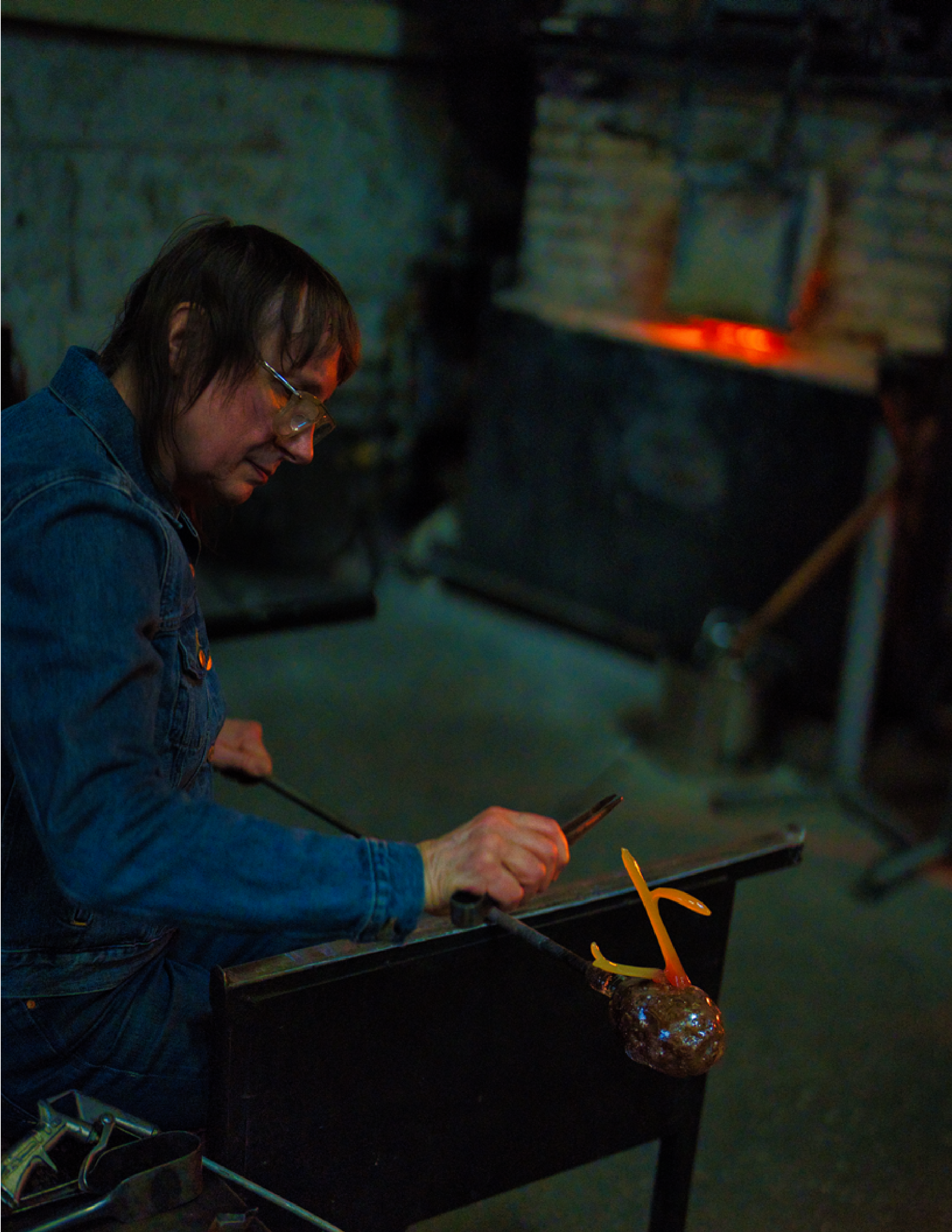
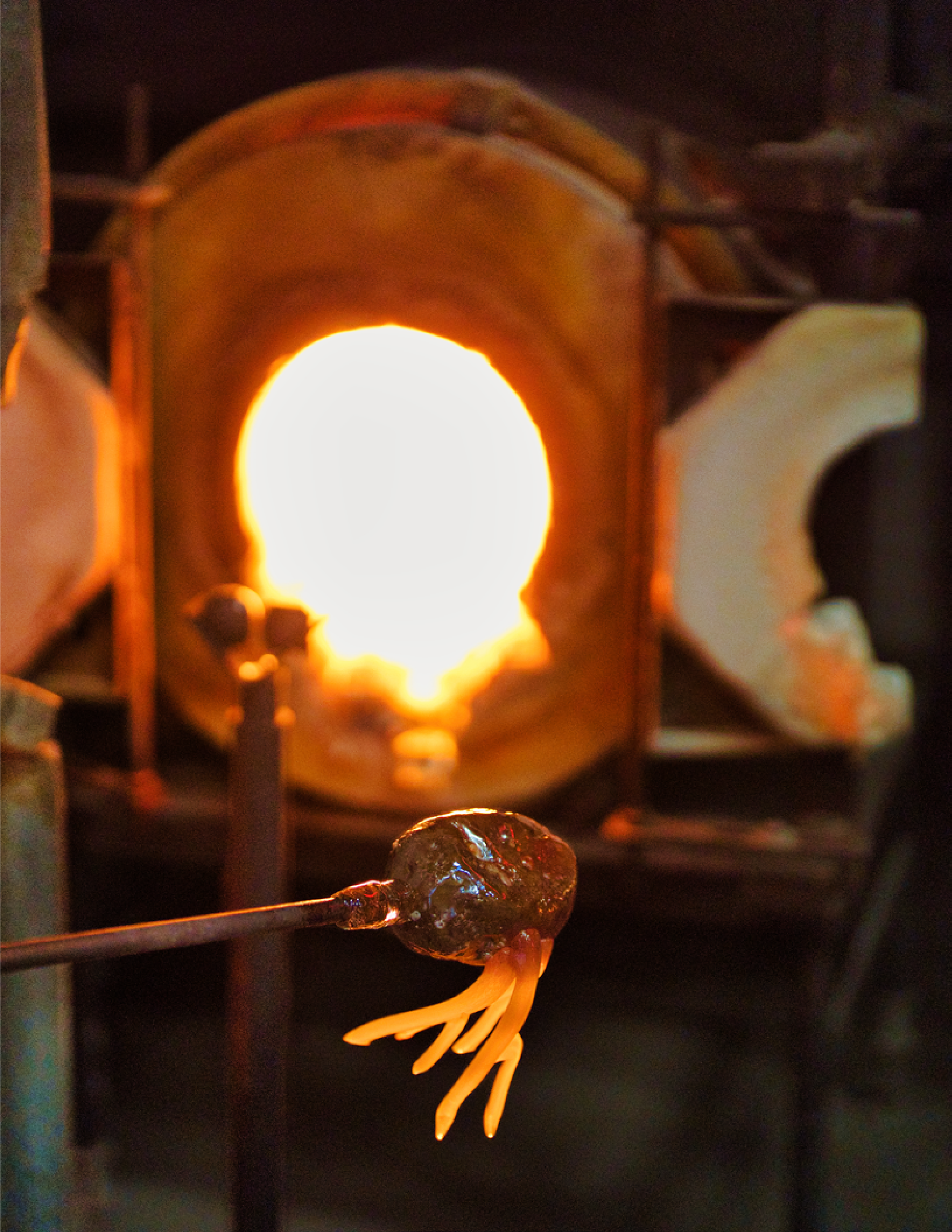
AM: So one of the things you made on this show were Forgotten Potatoes on one of the episodes.. So tell me about the episode. How did you came up with that? And they’re continuing in your studio and people are excited to order and get them?
DC: So that was a botanical-themed challenge. They came up with that challenge because one of the first things you make in glass when you touch it for the first time ever is this thing called a flower. It teaches you how to use the pincers and pull the glass out and it ends up looking something like a very rudimentary flower. I was like thinking about potatoes that sprout, and I really like them because they represent to me, these like unsung powerhouses. It’s not something that’s typically considered beautiful as a potato, yet here it is being this amazing powerhouse! Like, yeah you got your typical beauty which is a flower with its color and all its proportions, but I see the world in a different way - so many other things that could be beautiful and are beautiful and powerful and to me it represented marginalized people as very super powerful people that get disregarded and overlooked. They were represented in the Forgotten Potato and they are often forgotten or overlooked or pushed down and not allowed to shine, but the potato comes through no matter what!
AM: We made three of those together, which was awesome and I saw that you put a lot of effort into getting the exact hues and colors you wanted for the potato. So what’s involved with trying to recreate something that you created before and trying to stay true to the system, rather than creating a new thing as an artist?
DC: Well, the good thing about potatoes and sprouting, they’re endlessly variable - like consistently fascinating - they’re not boring, so it’s not like making a production line in that everyone’s the same. Each one has a little personality and people relate to them in different ways like and people really do relate to the Forgotten Potato or they relate to the metaphor behind the piece heavily. It really gave me a lot of faith in people in a way.
AM: And the sprouts were super cool. It was noted that the sophistication and quality of the sprouts is similar to fine stemware. So it really gets to show off both some of your superb skills and it also gets to relate to and maybe be something the owner gets to flaunt in a way.
DC: That they’re an art piece and has something as fine as stemware, there’s some people that might look to use it as a conversation piece with their guests. It’s challenging to make when you’re opening that up and trying to get it hot as it’s flopping all over the place in the hot box. The hot box is called what we have for our furnaces, and then reheat the glass in glory holes, many are now calling reheating chambers. A challenging part of it with young glass is timing that is really huge here… so you got to know your glass and and what temperature it’s it’s at because it will self-destruct if it gets too cold, and if it’s cold and then goes back into the glory hole which is super hot, it can shatter! In order to become a maestro at this, you have to make a lot of mistakes and work on a lot of different projects to get really good as a sculptor in glass.
AM: How do you generally decide what to make if you’re selling glass pieces?
DC: It’s not just selling, but having a place to put it, because I don’t have enough space in New York to just make stuff. So we thought about that as if I had a beautiful studio in upstate New York that I could bring my work and work on it, I would be creating worlds. I think worlds with these, I would probably make my garden like that. [Presently] there’s a practicality in that there’s the limit of space, and glass is expensive, and part of it is time making it.
AM: What’s the longest time you spent on a project?
DC: Probably one of the ones we mentioned already.. there was also a show I did a couple years ago with the Hannah Traore Gallery that took a couple years to put together. I’m known for it and it was involving mushrooms and their mycelial network that I made in neon so the mushrooms would communicate with trees which I made also in the galaxy called Creatures of Culture That was very popular recently.

AM: Oh, wow, that’s cool.
DC: So I made a tree out of mirrored mosaic, like how it would look like a disco ball. Then I brought in a thousand pounds of glass soil, which was broken up brown chunks of glass from a defunct factory in West Virginia that I brought into the gallery and put on the floor. That also had a queerdelier, it’s like a chandelier, but a queer chandelier because the mushrooms are like non-binary beings - they’re neither plant nor animal, so they have one foot in each category, because they don’t have photosynthesis they get their nutrients through enzymatic digestion.
AM: So if glass could talk back to you, what do you think it would say?
DC: Stop hurting me. That’s when you’re working it too cold. It feels so painful to the glass. You can see it like hates it. Okay. you’re pushing too hard trying to just get every working second out of the heat you just did, and you just go too far it always scars the glass, and it shows you it just went too far! I think it speaks to me most when it’s hot. So when it’s in this molten state. So once the sand and whatnot is heated together. Then it forms an identity, a personality. Yeah.
AM: What would you say the most absurd commission request you ever received was?
DC: Oh, David Letterman, to make glass soap for him. He wanted to use Christmas gifts. Oh I thought this guy is hilarious, because that’s the gift you give somebody when you don’t know what to give them! So he’s creating this glass soap, like when you don’t know what to give someone, you bring a housewarming gift or something, you get soap and candles as two of the biggest things. He was going to use it as a charming novelty to hand out to people saying, I normally would give you soap, but now I’m giving you elevated glass soap. I thought it was hilarious.
He had me make other things too. A tie. OK, then there’s the tie which he still had hanging over there from his son’s prep school tie when he was graduating. So he had me make that - then the tie broke - the tie was broken by someone cleaning the house and he wanted me to do something with the tie’s broken shards to make it into a new sculpture, so I edit those shards into like a big kind of paperweight. He is a fan of glass because he went to an undergraduate school that had glass in Indiana, and he really fell in love with the material. He made a documentary about making that [Editors Note: “Clear Reception” is the Documentary]. Also another thing - so he has a duct tape cell phone holder of different colors on it and it became this big mass of duct tape and plaid and he wanted that reproduced in glass, which I was able to do. He gets very attached to things!
AM: So what’s on your bucket list now?
DC: Well, I’m heading up to the Corning Museum. The next thing is I got asked to be in the show in Venice, so I have to make pieces for that, which I’m calling the project Big Fruit. I’m sticking with fruit. When I was thinking of what to do in Corning, I wanted to turn the fruit project into lighting.
AM: You had won a residency at Corning from the show, right?
DC: That was years ago, but now I applied. So I was two weeks in there, the museum hot shop… they have different hot shops there… I ended up making car parts there, because I was like let’s let me do something that’s not fruits or vegetables... so I made like a car mufflers with big plumes of exhaust coming out of them and hubcaps as the jewelry of the car. So my goal was non-toxic masculinity and that was represented by the car, so glass can transform anything that I thought into something gorgeous and beautiful.

AM: You worked on a cool project with Cake Boss as well?
DC: Oh yeah. That was another TV program. Yeah. Buddy Valastro - Cake versus Glass. His production team found me because he was doing a special for Christmas time or the holidays. It was going to be cake against other materials. And they reached out to me because they wanted to use glass. Glass was one of the mediums. Set design was one of the meat. Legos was one of the mediums. Toys was, I think. So they reached out to me. And they did a four-episode series, which is Buddy versus, and I was the Buddy versus Glass. Okay, I forget the exact prompt now, but it was something about “The Night Before Christmas.” And Buddy did a cake where Santa Claus crashed into a house. He does these huge elaborate installations with armatures underneath -
AM: Yeah they’re crazy! Our jaws were just dropped when we binged a Buddy Versus Duff season recently when we were working around the clock during on a staycation at Coda Williamsburg, ironic no? So much creativity, passion and skill for both of them!
DC: I did a christmas cookie that was out for Santa that got eaten by a mouse. So it was a mouse that ate part of a cookie, and the cookie thought the mouse was in love with it, but the mouse ended up eating the Christmas cookie, so it was not true love. We had two judges. He was on the left side of the stage and I was on the right side of the stage.
AM: So what happened?
DC: I won. He was great [about it].
AM: What are some of your favorite museums and gallery exhibitions?
DC: I like Friedman Benda Gallery. It’s a furniture art gallery. Salon 94. As far as museums go, my preference is the Whitney in New York. The gallery I showed in - Traore gallery. That’s cool. Gotham was doing an ashtray exhibit - they have a gallery in addition to the store where they show some lifestyle things like clothing, and also an art gallery. [Editor’s Note: The Exhibit is called “The Smoking Section.”] It’s a really cool art gallery because they do show things that maybe can’t go anywhere else, like an ashtray show. For that I used a traditional Venetian style goblet that has a dragon in the stem. It’s still there in their store.
AM: What are some of the things you like to do in your downtime when you’re not glass blowing or glass working?
DC: I do yoga okay with Three, because she teaches yoga and I don’t think it would be as fun if she wasn’t teaching. It’s great because that [helps] the flexibility part, especially as you get older, you have to keep limber. And then skiing, we went skiing. I’m a beginning skier, really, but I’m enjoying it. That’s new for me. Then dining and going to movies.
AM: How do you like having a studio office at Brooklyn Glass?
DC: Brooklyn Glass is like a shop that is really devoted to having artists fabricate their work. So there’s two shops near here. One is Urban Glass, which is a non-for-profit artist organization or arts organization. And then there’s this one, which is Brooklyn Glass. I like this one. Well, first of all, I have a studio within this one. And it’s really like a community here that’s a small community that I can rely on to talk ideas over and to help. And so it just feels like more of a community to me than the larger space down the street.
So I like that. And it’s just really focused on professionals here. They have an educational program, but it’s really only at night. So during the day, it’s all professionals working here, which is great. And it’s just a good range of projects coming through that you can see different things being made and different people coming in. They have several departments, including neon, fabrication, hot sculpting or hot blowing, and cold working the finishing area studios where drilling and grinding and cutting of the glass is done. So getting special shapes outside of what you can do in the hot shop. That’s here too. It’s a nice small shop.
AM: It was great making some Forgotten Potatoes together, we look forward to some Eggs & Fruit another time!
IG @dczeey
PHOTOGRAPHY CREDIT | Paul Farkas shot with Sony Alpha |


Read the MAR ISSUE #123 of Athleisure Mag and see MAESTRO OF MAGIC | Deborah Czeresko in mag.