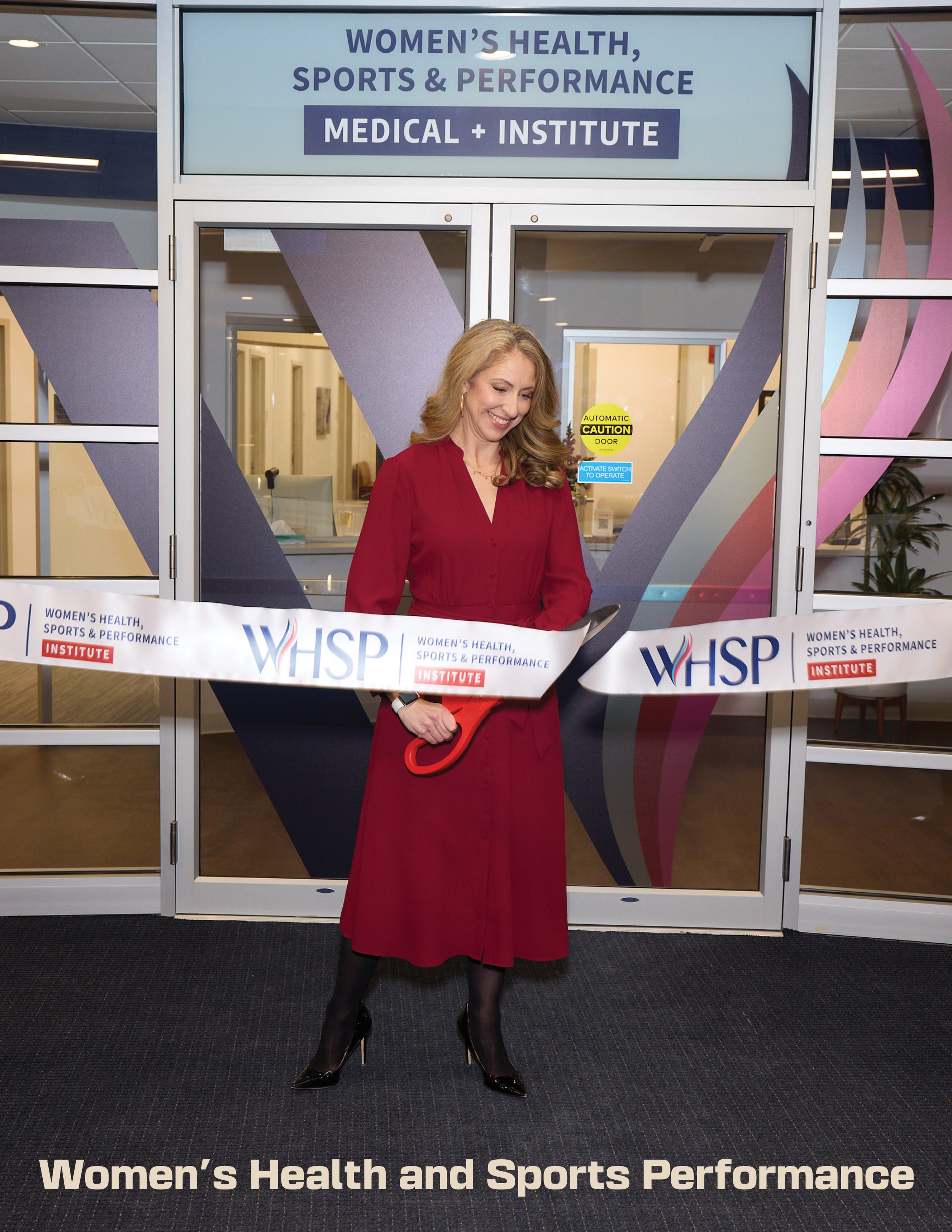

We had the opportunity to talk with various team members from Women’s Health Sport and Performance (WHSP) Institute which was Co-Founded by Dr. Kate Ackerman which integrates research, education, and specialized clinical care under one roof to advance female athlete health. With over $50 million in funding, it focuses on closing the gap in sports science, offering evidence-based, personalized care for female athletes across all ages and levels.
We wanted to find out a bit more about her background, her connection to athletes, and what we can expect from the institute.
ATHLEISURE MAG: Before we delve into WHSP Institute, can you tell us about your athletic background as you rowed in college and still row currently as well?
DR. KATE ACKERMAN: Yes. While I was an active kid, I was much more into music and theater before I got to college and discovered rowing. Rowing has been an integral part of my life ever since. I rowed throughout college, competed on the national team after I graduated, made lifelong friends and met my husband through the sport. I’ve been one of the US Rowing team physicians for almost 20 years and continue to row and sometimes compete as a masters athlete. That lived experience informs how I care for athletes and understand the physical and psychological demands of high-performance sport. It also reinforces my commitment to improving athlete health and safety across all levels.
AM: As a doctor, you have such an impressive background. Can you tell us about that and what led to you becoming the Co-Founder and Director of WHSP Medical and WHSP Institute?
DR. KA: My academic background really just evolved from curiosity. I believe in lifelong learning and I’m fortunate to have found things I’m passionate about. My clinical and academic career has focused on sports medicine and endocrinology, with a particular focus on female athlete health, and advocacy for women’s health and participation in general. Over time, it became clear that there were significant gaps in how we understand and care for female athletes and active women, from research to clinical practice. When generous donors with aligned interests came along (Clara Wu Tsai and Jane and David Ott), founding WHSP Medical and the WHSP Institute was a natural extension of that work. Our goal is to bring together clinical care, research, education, and advocacy in a way that is truly interdisciplinary and evidence-driven, while centering the unique physiological needs of women.
AM: You chair a number of committees from US Rowing Medical Committee, Co-Chair of the US Olympic and Paralympic Committee Women’s Health Task Force, member of the World Rowing Medical Commission, member of the Women’s Tennis Association Women’s Health Taskforce, and are a Deputy Editor of the British Journal of Sports Medicine. Why do you like focusing on female athlete health?
DR. KA: For far too long, female athletes have been underrepresented in research and underserved in clinical care. That gap has real consequences from injury risk to long-term health outcomes. I focus on female athlete health because it is a health equity issue and a performance issue.
When we better understand female physiology (for example, hormones, biomechanics) and girls’ and women’s sporting environments (such as access to resources and how they’re treated), we can learn how biology and environment interact and work to optimize health and performance.
So much of our sports medicine and sports science has been based on men. I’m happy to continue to care for male athletes. But it’s incredibly rewarding to be part of advancing the field of female athlete health, which is finally gaining the attention it deserves.
AM: What are your day-to-day roles and responsibilities at WHSP?
DR. KA: That part is a bit daunting! My role spans clinical care, research leadership, education, and organizational strategy. Clinically, I care for athletes with basic sports medicine musculoskeletal injuries to those with complex conditions, such as REDs, hormonal dysfunction, bone health issues, and medical mysteries. I love teasing apart complex medical conundrums– a collection of signs and symptoms that seemingly don’t have a connection, but may all fit together with the right investigation. I also enjoy working with our team of providers (sports medicine, nutrition, psychology, rehabilitation) to ensure we’re delivering comprehensive, evidence-based care. It is deeply satisfying to be able to provide quality care all under one roof, putting the needs of the whole patient first. On the research side, I help set our research agenda and guide projects that advance our understanding of female physiology and performance– from sample collection to writing protocols, study manuscripts, and eventually clinical guidelines. In addition, a large part of my role involves building partnerships, mentoring trainees, and shaping the broader vision of the Clinic and Institute.
AM: What are some of the research projects that you are excited about or that have been released?
DR. KA: We’re particularly excited about work focused on energy availability, menstrual health, and bone stress injuries in athletes. We’re also advancing research on how hormonal fluctuations may impact performance and recovery, which is an area that has historically been overlooked. Another key area is improving screening and early identification of relative energy deficiency in sport (REDs) and related conditions, so we can intervene earlier and more effectively. As we continue to expand our team of WHSP-based researchers and our team of international collaborators, we’re growing our work in the postpartum and postmenopausal athletes space, as well. All of this is with the intention of translating scientific discoveries into practical tools that clinicians, coaches, and athletes can actually use.
AM: What are some topics that you are looking forward to finding more about?
DR. KA: There is still so much to learn. I’m especially interested in better understanding the interaction between hormones and performance, particularly across the lifespan from adolescence through menopause. There is a lot of noise in the media and online about what girls and women should do to train, what they should eat, what supplements they should take, what they should be tracking. So much of it is at best, anecdotal. At WHSP, we’re testing theories to advance the science, in addition to creating a space where people can come for honest answers about what is really known thus far. At this stage of my career, I’m fairly good at reviewing data, understanding the limitations of certain hormonal assays and sports science study protocols, and interpreting scientific literature. And I’m humble enough to know that I want to be surround by excellence in other fields to make sure we have lots of talent investigating an issue. I love working on interdisciplinary research teams, because we all know a bit about each others’ fields, but together we bring much more depth to a project, which always makes the work better and more reliable. I have a deep sense of responsibility for ensuring we enlist diverse expertise, so that we can to do quality work and share findings in an accurate way.
AM: As we navigate 2026, what can we expect to see in terms of WHSP, whether it’s studies that have been released, activations, etc.?
DR. KA: In 2026, you’ll see continued growth in both our research and clinical programs, as well as the expansion of the WHSP Academy within the WHSP Institute. We are launching new studies focused on female athlete health and performance, while also increasing our educational initiatives for clinicians and athletes. Additionally, we’re building strategic collaborations across sports organizations and research institutions to accelerate progress in this field. Our goal is to continue leading with data-driven, impactful work that improves outcomes for female athletes globally.
AM: Tell me about the Biennial International Female Athlete Conference and what takes place there.
DR. KA: The Biennial International Female Athlete Conference is a cornerstone of our educational mission. Before WHSP was even a figment of our imagination, I co-created the FAC in 2013 to bring athletes, coaches, parents, health providers, researchers, and other experts together every other year to connect and share the latest science and best practices for female athlete health and performance. It was the first of its kind, and like what we’d like WHSP to be, it has become a bit of a mothership for how to bring people together to connect, collaborate, and learn from each other about female athlete health and performance issues. What started as a 2-day conference with under 300 attendees has grown into an inperson and virtual, 4-day, international event that sells out during early-bird registration and draws about 1500 people representing over 40 countries. We’re currently deciding if it should keep its present size and location for consistency and opportunities for people to effectively meet and connect. Like everything I’m excited about, the conference is highly interdisciplinary and relationship-building is an important element there. The FAC covers topics such as REDs, hormonal health, mental health, injury prevention, and performance optimization. I hope the FAC and WHSP continue to inspire and foster advanced knowledge for female athletes and positive change for women.
PHOTOGRAPHY COURTESY | WHSP Institute
Read the APR ISSUE #124 of Athleisure Mag and see WOMEN’S HEALTH AND SPORT’S PERFORMANCE.