We made our way to Olympic Week a few days ahead of the Opening Ceremony taking
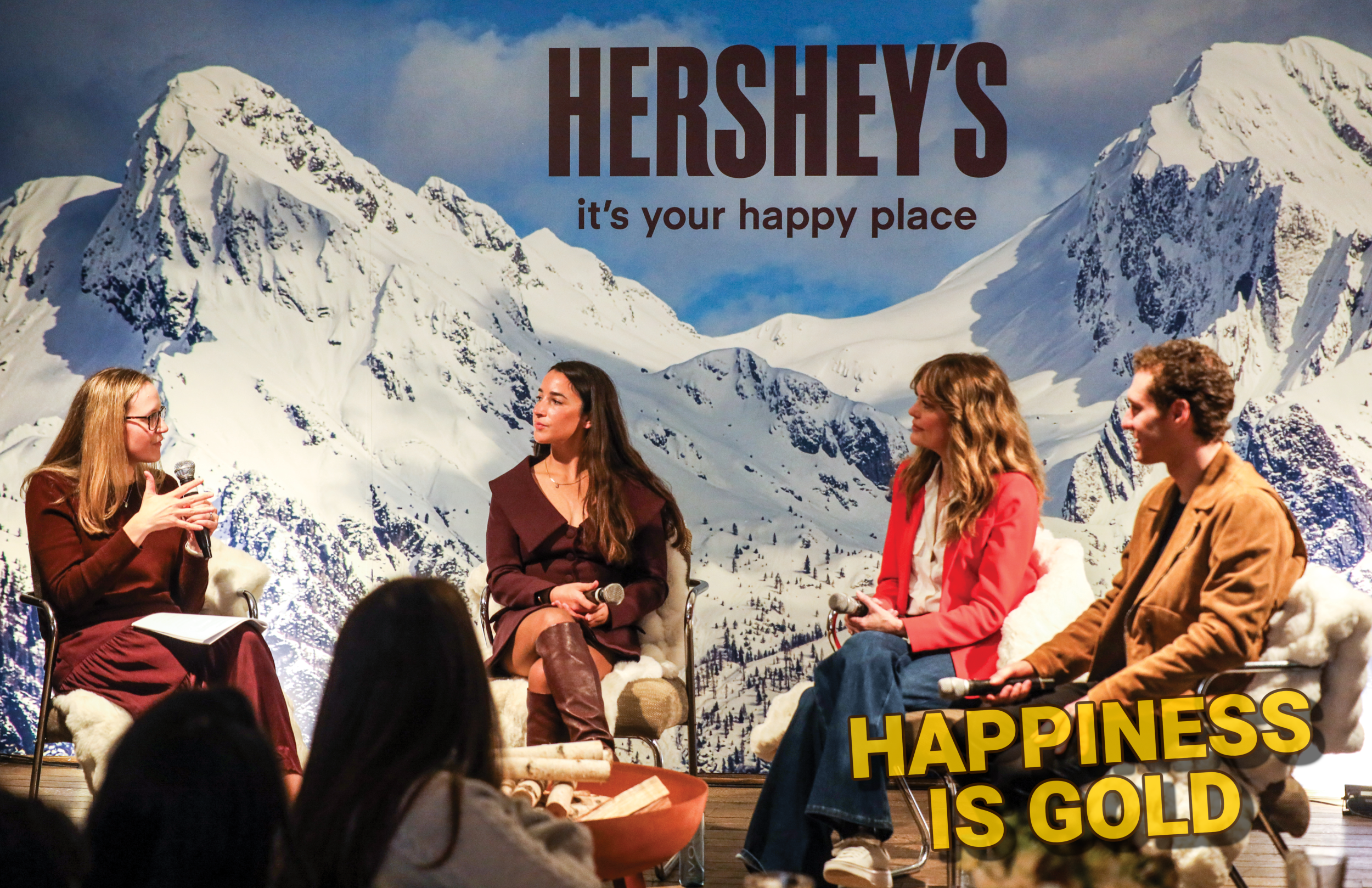
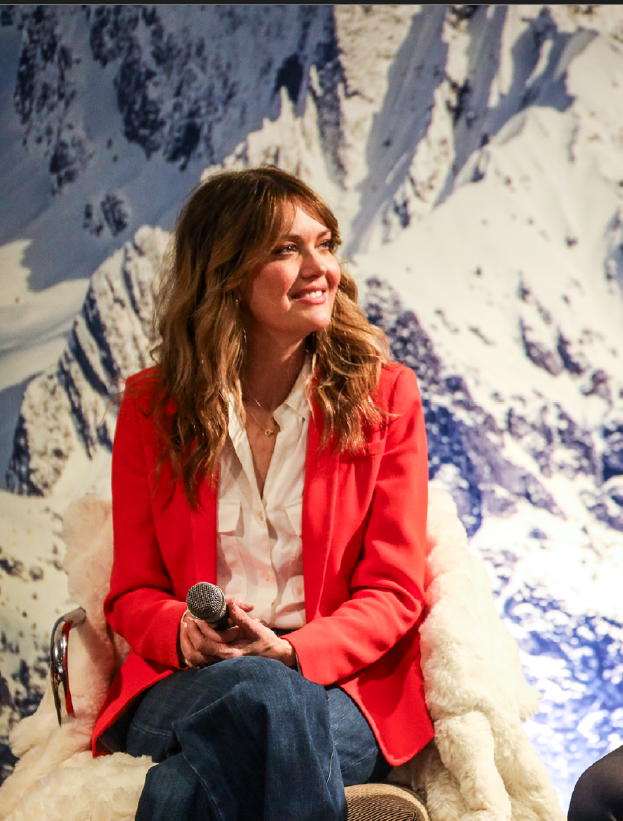
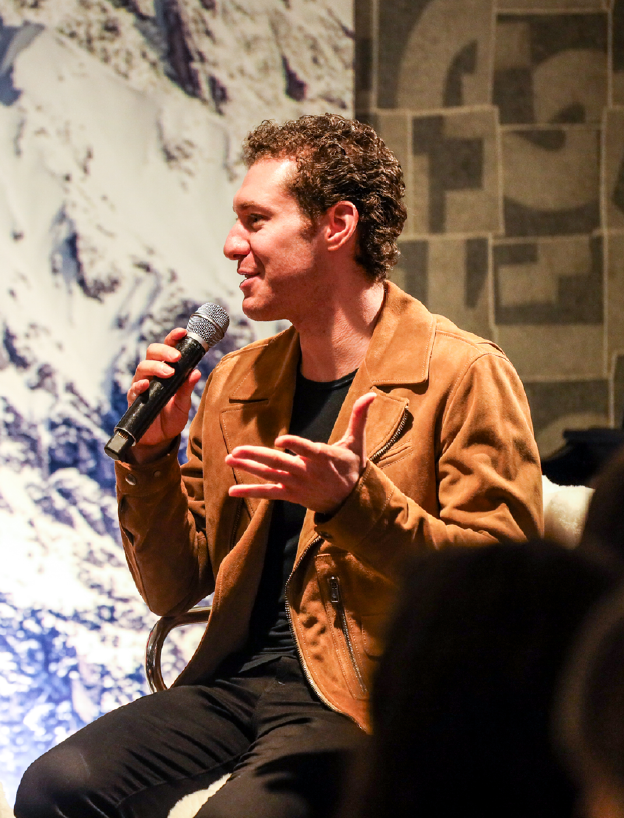
place for the Winter Games in Milano Cortina courtesy of Hershey’s for their Fireside Chat at SOHO House’s LES destination, Ludlow House. We had the opportunity to sit down to hear from Paralympic Team USA Snowboarder Amy Purdy (1S, 2B), and Olympians Team USA Gymnastics Aly Raisman (3G, 2S, 1B), and Team USA Figure Skating Jason Brown (1B). The 2 of them participated in a panel moderated by Hershey’s at the Hershey Company Senior Brand Manager, Katrina Vatter to talk about their Happiness Campaign featuring US Olympians. We heard about their athleticism, their passion for their sports and how they enjoy the happy moments that take place on and off the podium.
KATRINA VATTER: We are so pleased to be with all of you during Olympic Week and to have you here! I’m so honored to be doing my dream job and having a dream moment right now being here! Coming into this role, this brand has been around for over a 100 years but I felt that we have had this opportunity and this moment to bring what we do into the relevancy of today! Hershey’s has always stood for happiness. But for us, now more than ever, as we look around the world you see where we want to get happiness – this is where we got to to get to this campaign!
We knew that this campaign is a moment where folks are really striving hard for an incredible accomplishment and you know, happiness is really the goal here. This is an important moment to celebrate the achievements, but also to look at all of the hard work along the way. You can see the film that we created with our Olympic and Paralympic athletes and then we’ll have a nice chat with our athletes to talk about what happiness means to them and what it is sparking for them as well as we launch this campaign.
It’s my distinct honor to welcome our esteemed Olympians and Paralympian. Give it up for Jason Brown, Amy Purdy, and last but certainly not least, Aly Raisman. Thank you for being here again and thank you for participating in what I am deeming is a heart to heart on a Tues that looks at happiness and the meaning of life. The ability to have the balance\ to strive for something that you are really passionate about but then finding those moments along the way that make everything worth it.
To start us off, I’m a mom with 3 kids and I’m curious to hear how you guys got started on this journey? When you entered into your sport, what were those initial moments of pure happiness? My daughter’s dabbling and skating a little bit of gymnastics, and she just seemed like pure joy out there, and I know at some point that shifts into the competitive intensity, but I’d love to hear from you. Jason, what were those initial moments on the ice like for you?
JASON BROWN: So I fell in love with skating, cuz I have an older sister, and she took skating lessons, and it led to the annual ice show at the local rink. I saw her in that ice show and I saw all these kids skating to music in costumes, expressing themselves together, having so much fun. And it just was, like, I want to be part of that world, and I want to be able to express myself and I want to speak to music and I want to work hard to perform like that, and it just was like that pure happiness and joy that I just instantly gravitated towards.
KV: I love that!
AMY PURDY: I grew up in Vegas, which is not exactly where you expect a professional snowboarder to come from, but my family skied. I was horrible at skiing, but my friends snowboarded, and the first time I got on my snowboard, I just felt freedom like, I’ve never felt before. My sister was a cheerleader, so I was trying to be a cheerleader, and I didn’t make it. But then I found myself, I found myself. I found my friends. I found my passion it made me feel alive. I’d snowboard every day after school, which we had a lot of snow outside of Vegas at that time. I literally found myself and I knew that it was something that I would want to do for the rest of my life, didn’t know I would go on to compete, had no idea I would lose my legs at 19, and then go on to compete in the Paralympics so, but I just knew that I wanted snowboarding to be a part of my life in some way for the rest of my life, and it took me places that I never could imagine.
ALY RAISMAN: I started gymnastics when I was 2, and I just fell in love with it. I started with Mommy & Me classes, and I just can remember that I would daydream all day about going to gymnastics practice. And then, when I was 8, I watched the ‘96 women’s Olympic gymnastics team, and it was on a VHS tape, and I just watched it over and over again. I loved it and I think part of the magic of being a kid is that for me, it felt like there was no dream that was too big, and so I watched them. And at 8 years old, it didn’t occur to me about how hard it would be to get there, and that it was so difficult to make it. Now there’s only five gymnasts on that team, so it’s just there’s so little room for error. But at that age, I just sat in front of that couch and watched it over and over again, and I loved it. And I knew I, that was my passion. And I wanted to be out there. When I look at little kids doing gymnastics now to see the joy they have it just brings me back, and it makes me so happy. You know, my hope is that every kid has something that they love and makes them so excited. Whether or not that is sports, but I think about if every person in the world has something they were passionate about and they loved, I really think the world would be a much better and happier and more healing place.
KV: I love that. I love what all you guys said, that thread of, I can be free - I can finally be myself in this moment, kind of lose yourself. I think that’s so powerful. As you shift ahead, then to your Olympic/Paralympic journey, what were some of those things those comforting elements along the way that either took you back to the beginning or would help ground you as the competitive intensity would get started?
AP: I think one of the things that always kept me grounded was visualization. So, I’m a huge visualizer, I’m sure all athletes, are. You really need to be because you need to be able to see yourself win, you need to be able to see yourself perform in the way that you want to perform. And even when I lost my legs, I was laying in the hospital bed, visualizing myself snowboarding again, and I thought so vividly, and it makes me emotional to think about. I didn’t know how I’d do it, but I knew that I would. And then I did, and so I just kind of took that visualization into everything that I did standing in the staircase at the Paralympic Games, like visualizing every single move that I wanted to make, or even the night before, when I would get nervous and I think about, I’m going to make a mistake and I’m going to mess this up. You’re feeling the pressure, the world’s watching, and I’d just go back to visualizing. I would take some deep breaths, remember why I was there in the first place, knowing the impact that it makes to actually just be there and get the opportunity to be there. I would also just visualize as a means to ground myself for what I want to do and how I want it to feel and then kind of just letting it happen. So for me, that was very much a pretty nice grounding practice.
KV: Thanks so much for sharing and it’s super inspiring to hear that even in these very difficult moments, kind of like envisioning how you want it to be, how you want it to feel. Jason, how about you?
JB: I mean, there is as you mentioned, so much visualization that goes on. And even when Ali was talking about just that, seeing the kids at the gym for me, you know, as we get older and as the goals get bigger, we can get this tunnel vision and this focus and just be on the ice with it’s better just aspiring to better themselves. There’s just this unbridled joy around them. For me, when you’re skating to music, it’s like they’re skating to whatever song like warms their heart, and they’re just like running around the rink. Seeing the kids have that camaraderie with their friends, and that always brings me back to why I am in this sport. We have the opportunity in skating to perform in shows and that is another outlet where, when that focus on competition gets really heavy - you have that opportunity to express yourself to different pieces of music, explore yourself and who you are in different ways. That outlet is just so special and unique to the sport.
KV: The outlet piece or the balancing the intensity of the competition is a great element to highlight. It is something to see the unbridaled joy of children when they’re doing sports. It’s so fun to see the world, through kids eyes.
Ali, how about you?
AR: I loved both of your answers! I’m trying to think about something else that has helped me because both the visualization and then also just being around kids and seeing their joy has really helped me and impacted me, I think. Also, for me, being honest with other people - my support system about what I’m experiencing and what I’m going through. I think people tune in and might see the highs and the exciting moments of us competing at the Olympics, but there’s so many days where I don’t feel my best or I’m having a tough day, and so I think leaning on people in my life that I can go to for help and support, where I’m having a tough day or I’m just feeling a little bit off has been really critical for me in my gymnastics career, but then also post gymnastics career is just knowing that I’m not alone. And I think when I was younger, it was when I was competing in 2012 and 2016 that you know anxiety and depression wasn’t as much of a conversation as it is now. It’s still very stigmatized, but it’s still too many people are suffering in silence, but I think, as I’ve gotten older, I’ve really realized that when I’m vulnerable with my friends and open about what I’m experiencing it, it feels scary, but it also allows other people to open up and share what they’re experiencing and then, I think we form a deeper connection and relationship, and then I can feel like I’m getting better from it and able to work on myself in a way, and so I, I think leaning on my support system and being honest, especially in a sport like gymnastics where a lot of the things we’re doing are very scary and very dangerous. So I think communicating with my coach and letting him know if I felt a little bit off or felt like I might need a little bit more of a spot on something one day was very important, because, it’s hard to be at your best all the time. And it’s impossible. So I think allowing ourselves that Grace has been something I’ve had to learn and work on and being okay with asking for help and being comfortable with that, I think, has been one of the biggest gifts I’ve given myself is just letting go of this perfectionist mentality or having to be the best because I think being courageous and brave is being able to ask for help because we all deal with stuff. We’re all human.
KV: Thanks so much for sharing that. I think that’s super powerful. I feel like sometimes there’s always this pressure to be fine. But really, that power in connecting with somebody and opening up, helps you realize that you’re not alone and things like that.
As you think through where you guys started from and then heading into our Olympic/Paralympic Journeys, how does the definition of success change for you? What did success look like for you in the beginning, how did that evolve over time, and what do you think about it now after all of your accomplishments and achieving the heights of your athletic careers?
JB: Oh my gosh! It’s changed drastically I think throughout every experience. You know, when I was younger and still to this day, but my parents, I’m so grateful, celebrated everything. They celebrated every win. They celebrated every loss. Because of skating, I got to travel the world and compete all over. And we saw the world, you know when I would go to an event good bad, however, you know what? We took the next day to really explore the city that we were in and, and that’s something that I really don’t take for granted. And we did that when I was. young, traveling the Midwest. I’m from Chicago, and like we would be in Iowa and we’d see the city there, or if we were in Des Moines, or wherever we were. We really took the time to explore that place and I think that it really grounded me. But also, there was this level of happiness and joy that this sport that I loved was this vehicle to see the country and to see the world.
As I got older, of course when you have that tunnel vision, you have those goals. It gets harder and harder, and you know you want to grip on tighter and tighter. Having that reminder and having that perspective that my family always gave me in those tough moments win, lose, or draw - you wake up the next day you, you’re hungry for more. And I think what’s so incredible about this campaign, but also about that search for happiness is that it’s, it’s a constant thing that we seek that we have at times that comes naturally that we also struggle with.
You know, Ali talked about that anxiety and that pressure and being able to say I’m not okay, I’m not happy. How could something that I love so much, also tear me down in some moments, and how can I struggle with something and be okay with that? Being able to share those moments and it’s a constant learning experience.
It’s not something I think that we ever master or ever reach. It’s a constant striving to grow, learn and adapt. And I think that, as I got older, and the more I achieved, the more I learned that you just keep waking up hungry for that next experience.
AP: Well, I love what both of you guys are saying and along the same lines, so for me, how happiness has changed, and maybe success has changed. So I think earlier in my career going into Sochi, I put so much pressure on myself that even though I loved my sport and I loved what I was doing, I felt the pressure and that took some of the happiness away because I felt like this is my first time to show what we can do as Paralympic athletes. It was the first time that snowboarding was a Paralympic sport, and I was kind of the one to watch. And I was, like, I’m still trying to figure out what I’m doing myself, you know, and I hope I do good. And so, I put all this pressure on myself. I’d see myself on billboards, and I’d see myself on like, you know, in magazines and all this stuff, and I would just get so nervous, and so then, going into my second Paralympic Games, I thought I don’t want all that pressure. I just want to enjoy the ride. I just want to enjoy it because I might not have it forever. I know I won’t have it forever, and so I loosened up. I allowed myself to just be present and enjoy the ride. And then, now I am retired. And I would say success for me now is not trying to be the best, which is kind of as a perfectionist self that I’ve had to overcome, it’s trying to take care of myself, the best. And when I do that, then I show up as my best self. When I can sleep good, eat good, relax, listen to my body, listen to my mind, and let that pressure go. It’s really hard as athletes because you’re competing against each other. Even though you’re on a team, so you don’t necessarily feel like you can always open up to your teammates about what you’re going through, so you’re kind of like this furnace, you know, like, ready to combust, sometimes with all this pressure that you feel, but being able to really focus on self-care. Like now, if I’m not comfortable, I don’t want to do it. I used to be uncomfortable all the time. I’m pushing my comfort zone all the time. And now, I’m like, no, I can actually sit back, take care of myself, and enjoy what I’m doing. I can be present and make sure my head’s on straight, like that, feels like success to me to have that breathing room and to be able to do that.
AR: Can I ask you, what age do you feel like you got to that point where you felt comfortable prioritizing how you feel?
AP: Okay, so I’m 46 now, and I will tell you what one of the best things about aging is that’s what comes with it, because even I think when I was 40, so I actually got injured, severely injured, injured my left leg that knocked me out of my sport and everything until now. I’m still kind of working my way back, and it was really hard because I still wanted to show up. I still wanted to compete. I still wanted to be the best because I felt like I was at the top of my game when it happened. And then I had to learn some real acceptance of, like, I’m not gonna be what I was and really be able to do it. I was grateful that I didn’t, but then with that came this aging thing that, you know, so many people, especially women complain about right now - of how it feels when you’re in your mid-40s in your mid 50s. But for me, there’s a sense of calm that I appreciate so much. I don’t feel like I have to compare myself with anybody else. I’m proud of my accomplishments. There’s more than I want to do. There’s just this calm confidence that I’ve never felt in my life, especially being an introvert. I honestly think it’s also just age, and it’s something that we can really look forward to. And I find myself more happy in the little moments now.
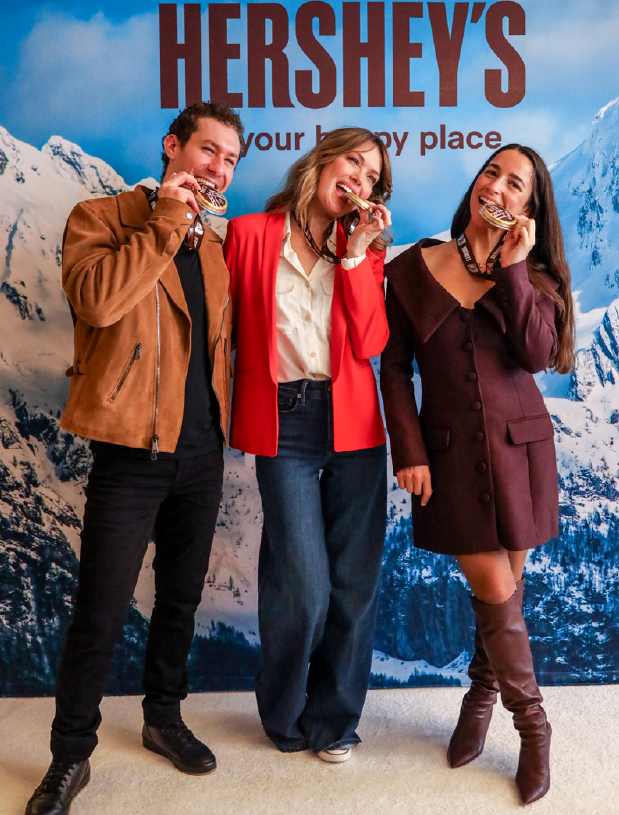
KV: I love hearing all of this and as we’re passing out some golden chocolate medals to you now, I would love to hear from you guys in your Journeys, whether growing up or at the Olympics and Paralympics, what was a moment where you’re like, no one knows about this, but like this deserves a medal! What are the small things that epitomize what it means to be happy along the way?
AR: I think I was pretty good at pin trading. Did you guys do that? It’s really cool, because at the Olympics, you have your credential and you’ve got pins, and not everyone speaks the same language. So it was really cool to be able to communicate with athletes from around the world and to trade pins, and I just loved it. And then you get to have all these really cool memories, and I became very competitive with it, and I loved it so much, and it was just a really nice, healthy distraction.
And then, I’d also say, my favorite moments from the Olympics, I love this Hershey’s Campaign because it really is meaningful to me when I think about my Olympic career. I’m not thinking about the podium. I’m thinking about really the fun times with my teammates, and we all still have such a great relationship, but we would laugh so hard when we weren’t at the gym, and we really, you know, when we’re at the Olympics, we’re in the Olympic Village. We’re training, eating, and sleeping. That’s it. And we just, it was, like, laughter, was the best medicine for us, at least for me. I can’t speak for my teammates. I was so stressed, and so to have that just being goofy and silly and just having fun together. I just cherish those moments so much because it really helped me stay grounded, and so the pin trading and the friendships that I made, I think, are my medal moments.
KV: I’ve heard about this pin trading situation. It sounds amazing and like the perfect balance to everything that you guys are experiencing.
AR: Do you guys have pins?
KV: We don’t! Next time for sure, we have to!
AR: Ok for LA the Summer Games for LA28!
KV: It’s happening!
Amy, how about you?
AP: I missed out on the pin trading in Sochi because I was so focused on competing and I didn’t realize that everybody was doing this whole pin trading thing until I went to my next Games!
It’s not really a moment, but I think it’s everybody who supported me on the path like they should get the medals because there was so much that went on behind the scenes that people don’t realize. I think about my doctors who saved my life, my kidney transplant doctor allowed me to do things that most transplant patients can’t do. I traveled the world, and you know, he knows that. So, he’s like, part of my team. I had engineers working on my legs. Prosthetists who make legs, literally working hundreds, if not thousands of hours on my legs, to get them comfortable enough for me to snowboard again. So for me, I think I’d turn the medal to give it to everybody who supported me on the journey.
JB: Truly what you guys both said, I wish I was a better pin trader to be completely honest. I was so nervous to go up to anybody. When I went to my first Olympics in 2014, I was just so star struck. I felt like a kid in the candy store! Just everything and everyone, I couldn’t believe that I was a part of something that I had grown up looking to. But what Amy said, it’s that support team. Many people don’t realize how much truly goes into it. You see these medal moments or you see these moments when we’re out doing the sport that we love and a lot of the times, it’s like game face on and you’re locked in. But like people don’t see all those scars or all those long days or all the good and bad moments and highs and lows that go into that. I think that those moments of perseverance, those moments of growth where you learn so much about yourself - and your team that unconditional support from them regardless win, lose, or draw. They’re like there the next day, being like, okay, how are we gonna turn this around, or maybe get better or learn from this moment? Or, and we’re here to celebrate. And I think that those are the moments that people don’t always see.
KV: I’m just curious if there’s any words of wisdom that you would give to your younger self or those striving to be where they want to be?
AR: I would tell myself to trust my gut. I think that we live in a world where at least I noticed this with gymnastics, where, from a very young age, I was kind of taught if I finished a cartwheel - I would immediately turn to my coach or the judge for approval, and I think along the way, I forgot to think about how it felt for me first. Because it’s a subjective sport, I was always seeking outside approval. I’ve just seen over the years, whether it’s parents or coaches and well meaning people. When a kid says, you know, oh, my foot hurts, or I’m kind of tired. They’ll say, no, does it. You’re fine, or they’ll push them to keep going.
And you know, sometimes, when we do ask for help, we don’t always get the support that’s important. So, to not give up until I find someone who does support me and does believe in me. It’s also about doing what makes me feel calm, gives me peace and prioritize what makes me feel good and be okay with saying no, which I’m still working on.
JB: I constantly struggle with the ability to trust my gut! I still, every single day, I’m fighting that battle, and like, trying and as Ali mentioned skating, being a subjective sport. There’s so many people giving so much input all the time that it’s very easy to lose your way in situations so huge, huge one.
I think another big thing that I learned along the way is there’s no one path. I think that we sometimes fixate on do X, Y, and Z - it will get to a certain point and I think that sometimes it’s A, B, and D. There’s just no formula in that sense, but if you are doing something because you’re passionate about it because you love it because you’re driven and motivated, that’s the formula to success, because as we have discussed today, the definition of success has changed drastically through our lives and what we think we want or what we think will be that definition or that defining moment, isn’t or may not be. I think some of the my lowest moments or some of the times where I haven’t trusted my gut and it’s gone poorly, I’ve grown the most because I’m never gonna do that again, and it’s taken me places that I never thought I could imagine. So, I think those are big things that I would definitely tell myself.
AP: I’m kind of along that journey as well. It’s not about the outcome talking about happiness and trying to find happiness. It really is the journey, and it really is finding purpose in the journey. If you can live in a way that you have purpose every day, a drive, whatever it may be.
Like what that taught us? It was just having this driven purpose is really what created so much happiness for myself, and so I would just ket my younger self know that that it really is in the pursuit of happiness that you find happiness, not once you win that Gold medal.
We truly enjoyed being able to hear from these 3 athletes while enjoying a very cozy lunch. We were given some time to sit with them to delve more into what they talked about on the moderated panel, as well as a few questions that we had that we know our readers and community would like to know more about as they were all heading to the Olympics as Aly was experiencing her first Winter Games, Amy is one of the Olympics Team USA Creators for the Olympics as well as the Paralympics, and Jason was a first alternate for Team USA Figure Skating.
ATHLEISURE MAG: We enjoyed hearing you guys on the panel and I’m glad we have some time to chat as our readers/community are always happy to hear from their favorite athletes and I have a few additional questions.
Happiness means what to you and where do you find it?
AP: I’ve just learned it’s not really about the outcome. It’s not about, like reaching the thing that you’re going after. It really is having purpose, so if I can wake up and have purpose in my day, that makes me take action that keeps me busy. That keeps me moving towards something that’s meaningful. That’s where happiness comes from for me. And I’ve even found it in my darkest days, so I severely injured my leg years ago. I already mentioned that, but, in some of my darkest days where I wasn’t walking at all, and I went actually a couple years like that. I had 10 surgeries in a 3-year time frame. I wasn’t walking at all and I didn’t know if I was going to walk again. I definitely didn’t know if snowboard would happen again or any of that.
AR: I just think that’s really powerful.
JB: How you said purposeful action! I think that combination, because I think you can feel like I have this purpose, but you feel stuck. I think that feeling of actually taking the action, taking the steps to move towards something whatever that might be, whether that’s that athletic goal, whether that’s a mission that you have or honestly, a relationship, and any in any given way.
AR: Those answers were so powerful. I really appreciate what they both said, and I think it’s really feels like what you guys are saying is such a value-driven answer and so meaningful. I really think about the fact that I’m almost 10 years out from competing, which is a really long time, and I think I’m sort of at a point in my life where I don’t think about my gymnastics career all the time, and I think for a long time my worth was defined by how I did or didn’t do, and I was so devastated and so hard on myself. If I didn’t do well. I try to think about if I Googled myself and deleted everything on there, who would I be and what would I be doing? I think when I try to really give myself time to reflect on what makes me happy - who am I with, What am I doing, where am I an really reflecting of even going to dinner with friends. Do I feel good about myself after? Does it feel like a really meaningful relationship? Do I feel really drained, or what are the types of things that I want in my future, and what am I doing to get there?
I also saw this thing online that said, if you were a movie and everyone was watching, what would they be screaming at you, telling you to do? I just think that’s really powerful.
JB: Oh my God!
AR: I tried to also give myself Grace and realize we’re all human. We all have good and bad days, and I think as long as we are trying to be in alignment with what’s important to us. I think that that’s a recipe for success, and I think success means something different to each of us. But for me, now, it just means waking up and feeling peace and spending my time with people that are just really good people. And then I can learn and grow from, like, you guys.
AM: The Olympics and Paralympics is such a global stage that you have all done. What did you love about doing that, and what are you looking forward to and looking at? I mean, we’re days away from 2026, which is exciting.
JB: I think for me. I think the fact that you get to share what you love to do with the world is so special. I think that is something that’s so rare and beautiful about the Olympic Games. I think that’s a reason why there is so much pressure to get yourself there because you know how not only rare of an occasion, it is, but also how badly you want to do what you love on the biggest stage and really get to share your passion with the people around you! As I’ve gotten older, and as I’ve experienced more, I think you do realize that you’re able to do that everyday. Like, regardless of an Olympics or not, but I do think that heightened attention is also something that you just, you just also know, and everyone around you. There’s a different energy and a different intensity and a different focus and a level of –
AR: Scrutiny?
JB: That too! It’s interesting, too. I think it. It brings out the best and the worst. I think it tests you and it challenges you and it teaches you. And sometimes, it’s like magic happens and sometimes you fall. It’s really tough. I think that’s the beauty of the Games.
AP: Okay, the very first Games was incredibly special because it was the first time that snowboarding was in the Paralympic Games. Snowboarding was my passion before I lost my legs. I lost my legs below the knees when I was 15, and all I cared about was snowboarding again. So I went on a mission to figure out how to do it, and I ended up building my own feet to snowboard in because there weren’t any feet at the time for snowboarding. And I knew the motion that I needed, and so I like built a pair of feet where I took like an ankle from one brand and a foot from another brand and turned the ankle around backwards and added all this wood under the heel and a bunch of duct tape, and I realized that I could snowboard with prosthetic legs.
At that point, my boyfriend, who’s now my husband, but we started a non-profit organization called Adaptive Action Sports so that we could help other people with disabilities snowboard, and through that we were able to help to get snowboarding into the Paralympic Games for the very first time. So we really kind of in the US, headed the charge to get snowboarding into the Paralympics. So, then, to actually be at the Paralympics in the start gates, thinking of everything that I went through to get there, even walking out in the Opening Ceremonies that was incredibly euphoric and emotional because I thought, oh, my gosh, it took losing my legs to get here. It took every little step along the way and we created a sport, literally created a sport, and it’s here, and there’s people from all around the world competing in it. It was just the most powerful experience to go, we did it, and you can create something that doesn’t exist and you can. And there’s people who believe in you and there’s other people doing it. And like, you can have a vision and actually have it come to life on the biggest stage in the world! What a cool life experience to know that you can put something out there and make it happen. It wasn’t just me, but like, collectively, make something happen that didn’t exist before. Now to sit back and watch because now snowboarding has been in the Paralympics and will be in it’s fourth Paralympic cycle.
I did 2 out of the 4. Now, I watch all these athletes from around the world like, it’s just grown. It’s taken on the life of its own. There’s athletes, I don’t even know. It’s, like, I mean, it’s unreal. The level of competition is huge. So for me, I get to be a super fan, and like I was a part of the beginning of it, and now I get to sit back and just be like, you know, in awe of what the athletes are doing so. I’m just really. I’m proud of it. I think I’m in a spot where I get to be, like, proud of it because we helped to create it and let it kind of launch and do its thing.
AM: That’s amazing.
AR: I’m going to be in Milan, so I’m very excited, and I feel so grateful that I get to be there to watch. It’s my first Winter Olympics getting to watch in person. So I think for me, this it also kind of, I think, allows me to really reflect on my own career, so I’m really looking forward to watching it and just being able to try to be present and just take in. You know, I think that in the Olympics you use this word and I use it too - there’s so much magic, and I think it really brings people together from around the world, and it’s a really beautiful thing that I’m really looking forward to is to be able to cheer on athletes from the US, but also from other places around the world and to hear other people’s stories and experiences and to see sportsmanship and to see so many wonderful stories and I think positive with social media is that we’re not just now hearing about the athletes that are on the top of the podium, we’re learning about athletes who you know in Paris, there was someone that was going viral for eating a muffin on TikTok.
ALL: Yeah!
AR: My teammates call me Grandma because I never know what’s what’s happening, but there was someone talking about eating muffins. People are now being recognized, not just for their performance, but for their sportsmanship. And just like their personalities and who they are, and that was really not the case when I was competing, and so I really like that because it’s too much pressure. And I think it’s not right to only showcase athletes who are winning, and I think the fact that we can really get to know who these athletes are and to hear about the amazing charities and organizations they’re starting is really wonderful. And that’s what I’m excited about it. I think this will hopefully be a pinch me moment just to be able to be there in that experience, and I’m really looking forward to it.
IG @alyraisman
PHOTOGRAPHY CREDITS | Hershey’s
Read the FEB ISSUE #122 of Athleisure Mag and see HAPPINESS IS GOLD in mag.